Places to Visit in Goa
Alorna Fort


Situated next to the Mahalaxmi Temple, the Boca de Vaca spring is one of the two springs that exist in Panaji Goa. The appearance of this Portuguese - built structure that remains aglow with soft decorative light in the evening gives it a name 'Boca De Vaca' literally meaning 'the face of the cow'.
The floor of the well-lit tunnel inside is made of transparent glass and one can see the spring water flowing under your feet. Background Music is also there.
Earlier the Boca de Vaca spring was known to be a major source of supply of water to the city. However even today the people of Panaji queue up here with buckets to use the water, as it is known to have medicinal properties. It is also used for drinking by the people of Panjim.

Contact Details :
The Dudh Sagar waterfall is situated in the Indian state of Goa in Sanguem taluka. It is located 60 kms from the capital city of Panaji and is well connected with Panjim and Margao through a rail and road network. Dudhsagar is even accessible through buses and taxis which can be taken from Panaji city.
Perched on the lofty peaks of the Western Ghats, the Dudh Sagar waterfalls offer unrivalled beauty, and amazing scenery full of exquisite charms when in full flux after the monsoon showers. Like an idyllic Eden cradled luxuriously in the mountains, the Dudh Sagar waterfalls, which from a distance appear like milky streams, gradually climax into a gushing cascade as they come into full view of the onlookers.
Dudhsagar literally means ocean of milk. This is one of Goa’s most attractive and ideal picnic spots mainly offering charismatic natural beauty and amazing scenery when in full flow after the monsoons. The waterfall initially appears like streams of milk flowing down the mountain which later culminate into gushing cascades after they come in full view of the awestruck visitors. It is perched on the lofty heights of the Western Ghats and falls from a height of603 meters . The celestial intervention in the origin of these waterfalls adds a mystic significance to Dudhsagar, almost like a dream come true. Even words are too less to describe this stupendous charisma of mythical fascination which is almost similar to a second Eden cradled luxuriously in the mountains.
There is a myth associated with Dudh sager waterfalls. Years ago there lived a powerful and rich king on the top of a mountain in the Western Ghats along the Goan frontier. He lived in a lavish palace made of pure ivory and embedded by precious stones. Near this palace, there were luxuriant gardens abounding in a vast variety of flowers.
At one end of the forest, which fringed the king's palace, there was a picturesque lake. In the panoramic setting of this lake, the king's daughter, accompanied by her ladies-in-waiting, went to bathe and to sip sugared milk which one of her maids served to her in a pure gold jug.
One day, while she was sipping at the milk, a prince, who was passing by, stopped on hearing the sound ofpeople nearby. Immediately, the princess poured the milk in the pond to shield her body from the glances of the stranger. It is believed that the sugared milk that was poured by the virtuous and modest princess still comes flowing down in torrents along that side of the mountain.
Dudh Sagar waterfalls with their strange, mystical fascination are a dream come true. The uneclipsed vision, furnished by this native waterfall as it plunges over crag-covered precipes and stupendous steeps, belies description.


The Fort Aguada is one of the largest and impressive forts preserved as one of the best known landmarks in Goanhistory. Its prominence has grown from the fact that its headland on which it is built offers a wonderful site for military architects due to its shielding of the vital sea access from the heart of the Portuguese territory thereby making it an ideal site for seaward as well as landward defense.
The elimination of the Maratha threat and the acquisition of the New Conquest added more glory to its importance right upto the end of the 18th century when Goa's future borders were established. The most vital part of it was its impregnability to survive attacks by enemies through land or sea or simultaneously from both sides which often happened.
The most feared threat for the Portuguese came from the Europeans in the east, which came true when a Dutch squadron approached the Mandovi in 1604. The Reis Magos Fort, Gaspar Dias Fort and the Cabo Fort proved to be futile in keeping them at bay and though eventually warded off, the Dutch succeeded in burning quite a number of Portuguese ships. In 1606, they returned back and settled at the entrance of the river, blocking the harbour and preventing the entry or departure of all the ships.
The Portuguese naval strength was now actually not enough to face the Dutch for an open sea battle whereby they had to resort to defensive methods against the Dutch to keep them at a safe distance meanwhile work on building a fort was started on the headland which was completely finished in 1612. During the reign of the Catholic King Dom Filippe of Portugal, the construction of the fortress began with orders from the municipality levying 1 percent duty towards protection and defence of ships approaching the fort. The Fortress was finally completed in 1612 by the members of the Municipality under the administration of Viceroy Ruy Tavara.
The water link with the sea on the north side was extended with the use of the Nerul river which dissolves into creeks beyond the peninsula and the whole of the headland was utilized as well making it a thoroughly defensible island. The fort was built as per the design laid down by the Italian military architects employed by the Portuguese government in Lisbon. On the highest point of the headland, there is a citadel which is linked by a defended passage to the riverside. The entire area at sea level is surrounded by fat walls with occasionally occurring bastions along the riverside. The outer wall part has now disappeared though there are still fragments which can be seen, distinctively along the river.
A delight for a military architect was the position of the fort citadel situated at the heart of the fort on the western tip of the headland commanding any seaward approach. It is now used as a jail outside the area of the fort and can still be visited. Similar to all forts built by the Portuguese where the fort configuration usually conforms towards the ground, this one is in form of a square with bastions for artillery placed at each of its three corners, while the fourth corner is occupied by a main gate. Each of the three corners are strongly defended by a dry moat and extremely thick walls while the fourth faces out on the steep slope towards the river. The embrasures are far and wide enough to allow a broad field of fire for the cannons. At one time, 200 cannons were a part of this fort, quite a massive artillery! The bastions are arrow shaped with rounded corners.
The solidity of the Aguada fort can be seen from the fact that neither this one has any delicate turrets nor the battlement lines are bisected by any towers. The citadel gateway being narrow is also blocked by heavy and iron studded doors thereby preventing easy access. The narrow bridge over the ditch makes it all the more difficult while the ramp into the fort inside the gateway curves off at a sharp angle and the steep steps upto the battlements do not make access any easier either. The 1st lighthouse was built here two and half centuries later. The main gate has a magazine adjacent to it, which has a unique half round design in order to deflect any enemy shots.
One of the distinctive features of the Aguada headlands are the Lighthouses built as early as 1864 thereby marking them as one of the oldest and first lighthouses to be built in Asia. Earlier to this, ships were normally guided by bonfire beacons lit on the Hill of the Pilots above the Immaculate Conception Church at Panjim. The 1st lighthouse initially built served purpose right upto 1976 when it was replaced by a square, modern lighthouse located nearby the walls of the citadel. This one is open to visitors and it makes all the watching more enjoyable due to the scenic views one gets to see when he/she climbs up the spiral staircase with a metal ladder within the lighthouse.
The old model is a splendid structure, and form a distance dominates the skyline. The Viceroy, together with the architect and engineer, is suitably, commemorated on a copper plaque in the ‘turret’ of the tower. Somewhat squat and with a solid appearance relieved by a balustrade around the platform and a curving staircase up to the lamp housing, it is most satisfying building. This is where the great bell from the Augustinian church in Old Goa was brought before being transferred to Panjim Church. Wherever it was hung it must have deafened the light house the lighthouse keeper. There is a third and smaller lighthouse, the Aguada Beacon, at the foot of the slopes near the buildings on the river bank. Built in 1890, it marks the entrance to the river.
The splendid structure of the lighthouse has a turret in which on a copper plaque are built and commemorated statues of the Viceroy, together with the architect and the engineer. The building has a solid appearance with the presence of a balustrade around the platform with a curving staircase to the lamp housing. The great bell from the Augustinian church was initially brought here before getting transferred to the Panjim church. Its peals must have deafened the lighthouse surroundings not to mention, the lighthouse keeper too. A smaller lighthouse, ‘The Aguada Beacon’, built in 1890 near the foot of the slopes besides the buildings on the river bank, marks the entrance to the river.
The lighthouse is surrounded by magnificent places where Panjim lies to the east along the river, with its Miramarand Caranzalem beaches leading to the Cabo with the Governor’s house on its point. Beyond the lighthouse lies the estuary of the Zuari river and the Mormugao port with the islands of St. George and Cambariem offshore. On the western side lie the famous northern beaches of Baga and Calangute. While the Candolim church is located inland to these beaches.
A huge underground cistern beneath the steps leading down from the centre of the citadel courtyard provides the water supply with its arched caverns having a capacity of more than 10 million litres or two and quarter million gallons to be precise. This was enhanced by the presence of several springs of clear sweet water which were instrumental in the naming of the fort Aguada which literally means ‘a place for watering’.
Another significant aspect of the Fort Aguada was the small chapel dedicated to ‘Our Lady of Good Voyage’, this being named due to ships anchoring at this place after a long journey and restocking before embarking on another journey. A jetty extends out towards the sea on the northern side where the Taj Group hotel is located just within the outer walls of the fort. The canon provides the necessary fire cover at the foot of the steep slopes, hidden from the guns of the citadel above. The cistern was excavated which in turn arranged for the stone from which the fortress walls were built. The fortress has many passages and rooms and narrow steps leading into more deeper and darker passageways to lost magazines and storerooms.
Parallel walls form a defensible passageway which connect the citadel with the anchorage below, where at river level, there are located old buildings not to forget the first chapel already mentioned above. The largest of all springs, the Mother of Water or Mae de Agua is also found here. This part of the fort is closed for visitors as it is utilized as a prison. At the new gates to the prison area, there is a statue of a man and a woman, the man holding the body of a child in his arms while the woman has her arms raised to show the breaking of chain bondage in front of the national emblem of India, the Ashoka Pillar which has an inscription which is dedicated to the memory of people, dead and alive, known and unknown and who have laid down their life for the cause of freedom from foreign powers.
The ceremony for commemoration of the beginning of the struggle is held on 18th June each year. The prison was in extensive use as it housed the revolutionaries of the 19th century when in 1946, the first peaceful non violence movement was initiated. All through the fight for freedom, nationalist supporters found themselves imprisoned here. The barrack built by British forces at the beginning of the 19th century during the Napoleonic Wars is no longer visible now.
Contact Details :
Directions :
Alorna Fort
The Alornau fort is situated in the Village of Alorna which is about 30 km from Mapusa and 10 km east off NH 17 from Malpem in Pernem. It was built by the Bhonsles of Sawantwadi in the 17th century.
The fort had four guns and in the year 1746, the fort was captured by Marquis of Castello Novo (later known as Marquis of Alorna) from the Bhonsles. The possession however was short lived.
In 1781, the fort was again captured by Dom Frederico Guilherme de Souza. It was used to defend against the Maratha attacks from the north.
The fort is presently in a dilapidated condition. It is however a beautiful site to explore as it is perched on the banks of the river Chapora as it flows peacefully towards Colvale.
The fort had four guns and in the year 1746, the fort was captured by Marquis of Castello Novo (later known as Marquis of Alorna) from the Bhonsles. The possession however was short lived.
In 1781, the fort was again captured by Dom Frederico Guilherme de Souza. It was used to defend against the Maratha attacks from the north.
The fort is presently in a dilapidated condition. It is however a beautiful site to explore as it is perched on the banks of the river Chapora as it flows peacefully towards Colvale.
Amthane Dam

The Amthane dam lies in a splendid location approximately 20 km from Mapusa. It is not yet developed for tourists and picnickers but is a nice place to unwind.
The dam supplies raw water to the nearby Sanquelim water treatment plant. It is not a big one but has a scenic view of the catchment and Sahyadri range beyond from the mouth of the dam.
The Amthane dam can be visited by taking the left side of the fork from the Assonora bridge, instead of driving to Bicholim. For accommodation here one can get an eco resort in Sal that offers food and stay.
Other places to visit include the Tilari dam which is about 20 km from Dodamarg in Maharashtra. The river Chapora also flows nearby.
The dam supplies raw water to the nearby Sanquelim water treatment plant. It is not a big one but has a scenic view of the catchment and Sahyadri range beyond from the mouth of the dam.
The Amthane dam can be visited by taking the left side of the fork from the Assonora bridge, instead of driving to Bicholim. For accommodation here one can get an eco resort in Sal that offers food and stay.
Other places to visit include the Tilari dam which is about 20 km from Dodamarg in Maharashtra. The river Chapora also flows nearby.
Ancestral Goa Museum / Big Foot


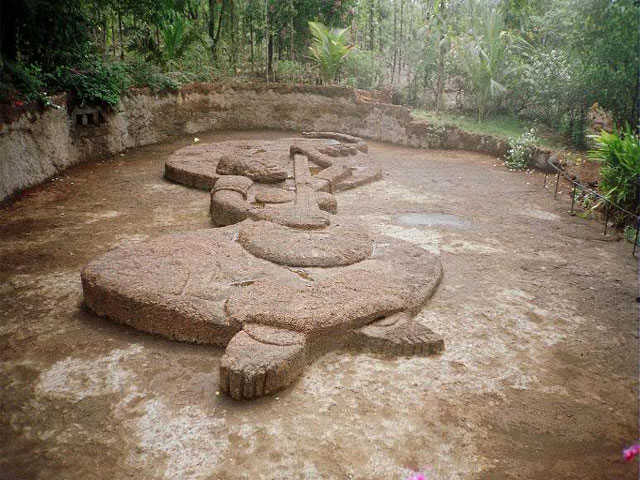
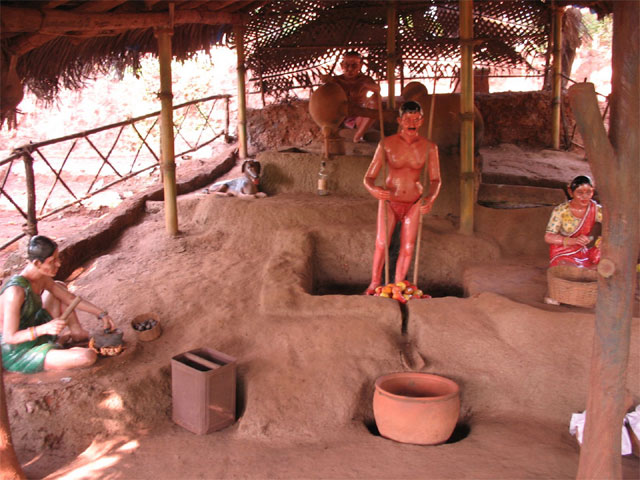
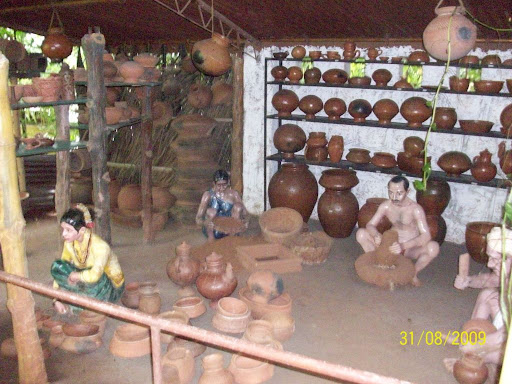
The Ancestral Goa museum/ exhibition is situated in the small Village of Loutolim which is about 10 km from Margaoand 25 km from Panaji. The musuem is also known as big foot. It is privately run by an artist called Maendra Jocelino Araujo Alvares. The open-air museum recreates Goan rural life as it was a hundred years ago.
At Ancestral Goa there are a number of places to visit such as an art gallery where one can see work done by local children and artists of State and National fame. There is a handicraft centre where one can get some locally made Goan artificats, Big Foot dance floor, Big Foot restaurant, a cross, a spring known as Boca da Vaca, a bird habitat, a spice yard, rubber plantations and lots more.
In this model village one can also see different miniature houses that showcase traditional occupation and social classes such as fishermen, Goan artisans, a Music school known as Escola da Musica, farmers, liquors shops, the village market, and a feni distillery.
The main highlight however at Ancestral Goa is the giant 14 meter sculpture of Sant Mirabai carved in 30 days by MJA Alavres the enterprising artist cum museum owner. This has been cited in the Limca book of records for being the longest laterite sculpture in India.
At Ancestral Goa one is accompanied by a guide who explains the exhibits. Also one can purchase souvenirs on the way out from the handicraft centre. The museum is open on all days from 9 am to 6 pm and has a small entry fee.
At Ancestral Goa there are a number of places to visit such as an art gallery where one can see work done by local children and artists of State and National fame. There is a handicraft centre where one can get some locally made Goan artificats, Big Foot dance floor, Big Foot restaurant, a cross, a spring known as Boca da Vaca, a bird habitat, a spice yard, rubber plantations and lots more.
In this model village one can also see different miniature houses that showcase traditional occupation and social classes such as fishermen, Goan artisans, a Music school known as Escola da Musica, farmers, liquors shops, the village market, and a feni distillery.
The main highlight however at Ancestral Goa is the giant 14 meter sculpture of Sant Mirabai carved in 30 days by MJA Alavres the enterprising artist cum museum owner. This has been cited in the Limca book of records for being the longest laterite sculpture in India.
At Ancestral Goa one is accompanied by a guide who explains the exhibits. Also one can purchase souvenirs on the way out from the handicraft centre. The museum is open on all days from 9 am to 6 pm and has a small entry fee.
Anjunem Dam


The Anjunem Dam is located on the Sanquelim-Belgaum highway in Chorla ghat at about 10 km from the Sanquelim town. It is one of the most idyllic places to enjoy the mystic charm and greenery around.
The dam lies in a sylvan valley formed by the proximity of another peak, Morlemgad to its south-east and below one of Goa's highest peaks, Vagheri hill.
For accommodation, there is a foret department rest house at Keri and an irrigation department rest house above the dam. There is also a private eco resort in Chorla ghat.
The ambience at the Anjunem dam is so enchanting that visitors return to the spot every monsoon or even during other seasons.
The dam lies in a sylvan valley formed by the proximity of another peak, Morlemgad to its south-east and below one of Goa's highest peaks, Vagheri hill.
For accommodation, there is a foret department rest house at Keri and an irrigation department rest house above the dam. There is also a private eco resort in Chorla ghat.
The ambience at the Anjunem dam is so enchanting that visitors return to the spot every monsoon or even during other seasons.
Arvalem Waterfalls


The Arvalem or Harvalem waterfalls, which cascades down from the mountains, from a height of 50 metres, is one of the most awe-amazing spots. It is situated at about 2 km from the small town of Sanquelim and 8 km fromBicholim, in North Goa.
The Arvalem Waterfall is a very scenic and beautiful picnic spot. This charming waterfall is a mind-blowing experience, with Rudreshwar Temple in its vicinity. The temple holds importance for the Hindus who believe in releasing the soul on the 12th day after death.
While leaving the temple of Rudreshwar, one can descend the staircase to look at a majestic waterfall shedding its exuberant silvery showers. The beautiful Arvalem fall, with a head of about 24 feet high, forms a sizeable lake at the bottom, which offers a sizeable temptation to seasoned swimmers.
The best time to visit this site is just after the copious monsoon when it presents a rapturous, ravishing and riotous aspect. The water flow here during the monsoon is quite less. It has a lot of greenery all round with fruitladen trees with various fruits such as bananas, bread fruits and coconut palms to name a few.
The ancient caves in the vicinity adds a touch of antiquity to this picturesque place, which finds a major attraction for the film makers as a favourite shooting spot. The Rock cut caves are just situated nearby. The Government has also developed a park from which the view of the waterfall can be peacefully relished.
The Arvalem Waterfall is a very scenic and beautiful picnic spot. This charming waterfall is a mind-blowing experience, with Rudreshwar Temple in its vicinity. The temple holds importance for the Hindus who believe in releasing the soul on the 12th day after death.
While leaving the temple of Rudreshwar, one can descend the staircase to look at a majestic waterfall shedding its exuberant silvery showers. The beautiful Arvalem fall, with a head of about 24 feet high, forms a sizeable lake at the bottom, which offers a sizeable temptation to seasoned swimmers.
The best time to visit this site is just after the copious monsoon when it presents a rapturous, ravishing and riotous aspect. The water flow here during the monsoon is quite less. It has a lot of greenery all round with fruitladen trees with various fruits such as bananas, bread fruits and coconut palms to name a few.
The ancient caves in the vicinity adds a touch of antiquity to this picturesque place, which finds a major attraction for the film makers as a favourite shooting spot. The Rock cut caves are just situated nearby. The Government has also developed a park from which the view of the waterfall can be peacefully relished.
Arvalem Caves


Just passing the town of Sanquelim, there is a detour road leading towards Arvalem Caves. These caves from the 6th century, are quite small, with no articulate sculptures or paintings.
The origin of these caves is uncertain, some believing them to be of Buddhist origin, although the presence of lingas does not justify this statement claiming them to be of Brahmin origin.
They are also claimed to be known as the Pandava caves, signifying the reign of Pandavas here during their 12 year exile as described in the Mahabharata. The shafts of the four carved lingas inside the cave resemble to those found at the famous Elephanta and Ellora caves.
The Arvalem caves are very much patterned in the Buddhist cave style, rock cut into laterite stone, with the sanctuary at the northern end and the vihara at the southern end.
The claim of the caves being of Buddhist origin is a justified statement, mainly due to the discovery of a huge Buddha statue nearby and a 4th century Buddha head found in the Mhamai Kamat house now installed in the Goa State Museum.
The origin of these caves is uncertain, some believing them to be of Buddhist origin, although the presence of lingas does not justify this statement claiming them to be of Brahmin origin.
They are also claimed to be known as the Pandava caves, signifying the reign of Pandavas here during their 12 year exile as described in the Mahabharata. The shafts of the four carved lingas inside the cave resemble to those found at the famous Elephanta and Ellora caves.
The Arvalem caves are very much patterned in the Buddhist cave style, rock cut into laterite stone, with the sanctuary at the northern end and the vihara at the southern end.
The claim of the caves being of Buddhist origin is a justified statement, mainly due to the discovery of a huge Buddha statue nearby and a 4th century Buddha head found in the Mhamai Kamat house now installed in the Goa State Museum.
Banastari Bridge

Banastarim is situated at about 16 kms from Panjim and 12 kms from Ponda in Goa. It has a government school and a sports club. There are three temples in the area as the Village shares a large hindu population. However the village is mainly known for its market which starts filling from Thursday evening and get full by Friday morning every week.
Banastarim is also known for the Meta Bridge. The bridge in Banastarim sometimes called the Banastarim Bridge is an important link to the Tiswadi and Ponda taluka as well as to the Mandovi River. Major of the West Side of Banastarim is surrounded by the river.
Banastarim is also known for the Meta Bridge. The bridge in Banastarim sometimes called the Banastarim Bridge is an important link to the Tiswadi and Ponda taluka as well as to the Mandovi River. Major of the West Side of Banastarim is surrounded by the river.
Boca De Vaca Spring


Situated next to the Mahalaxmi Temple, the Boca de Vaca spring is one of the two springs that exist in Panaji Goa. The appearance of this Portuguese - built structure that remains aglow with soft decorative light in the evening gives it a name 'Boca De Vaca' literally meaning 'the face of the cow'.
The floor of the well-lit tunnel inside is made of transparent glass and one can see the spring water flowing under your feet. Background Music is also there.
Earlier the Boca de Vaca spring was known to be a major source of supply of water to the city. However even today the people of Panaji queue up here with buckets to use the water, as it is known to have medicinal properties. It is also used for drinking by the people of Panjim.
British Cemetry in Goa


The military or the British cemetery was built in Goa in 1802 by the British. It is considered to be more than 180 years old and is the only reminder of the British occupation of the territory of Goa during the Napoleonic period.
During the Napoleonic wars from 1799 to 1813, the British military cemetery was built to serve the purpose of a British garrison of Rs.10, 000 men who were stationed at Fort Cabo to prevent Goa from falling into French hands.
The cemetery has 56 gravestones and 47 tombstones, the earliest that date to 1808 and the last to 1912. It can be reached by taking the road connecting the National Institute of Oceanography (NIO) with the Raj Bhawan.
Near the British cemetery one can visit the Cabo Raj Bhavan also known as the Governor's Palace, which is the official residence of the governor of Goa. Also one can visit the Our Lady of Cabo church that is situated nearby.
During the Napoleonic wars from 1799 to 1813, the British military cemetery was built to serve the purpose of a British garrison of Rs.10, 000 men who were stationed at Fort Cabo to prevent Goa from falling into French hands.
The cemetery has 56 gravestones and 47 tombstones, the earliest that date to 1808 and the last to 1912. It can be reached by taking the road connecting the National Institute of Oceanography (NIO) with the Raj Bhawan.
Near the British cemetery one can visit the Cabo Raj Bhavan also known as the Governor's Palace, which is the official residence of the governor of Goa. Also one can visit the Our Lady of Cabo church that is situated nearby.
Budbudyanchi Tali

The Budbudyanchi Tali or the Bubble lake also known locally as Budbud Talli or Bomadyanchi Talli is located in Netravali in the Sanguem taluka. It is a sacred tank of bubbles attached to the Gopinath temple and appears to be green and very clean.
The Budbudyanchi Tali or the tank of bubbles is well known in Goa as here one can see continuous bubbles rising up to the surface at different spots. There are various legends regarding the origin of these bubbles and according to some it is a miracle of the local deity. However, according to scientists, the bubbles can be caused by sulphur dioxide, carbon dioxide, limestone or methane.
The bubbles at the Budbudyanchi Tali are known to strangely increase in intensity if one claps loudly. The tank in form of laterite masonary has a flight of steps all around leading to the sacred tank. A huge box-shaped laterite pedestal is located at the centre of the tank.
The Budbudyanchi Tali or the tank of bubbles is well known in Goa as here one can see continuous bubbles rising up to the surface at different spots. There are various legends regarding the origin of these bubbles and according to some it is a miracle of the local deity. However, according to scientists, the bubbles can be caused by sulphur dioxide, carbon dioxide, limestone or methane.
The bubbles at the Budbudyanchi Tali are known to strangely increase in intensity if one claps loudly. The tank in form of laterite masonary has a flight of steps all around leading to the sacred tank. A huge box-shaped laterite pedestal is located at the centre of the tank.
Cabo De Rama


Cabo De Rama is situated 16 km north of Agonda beach in the coast road at the south end of Colva Bay. Also known as The Cape of Rama, it takes its name from the Hindu epic Ramayana hero, Lord Rama as according the Hindu belief Lord Rama during his exile from Ayodhya stayed here.
The cape is crowned by a fort which was originally a Hindu structure and rebuilt by the Portuguese in 1763 after acquiring it from the Maratha ruler of Sonda. It had 21 guns for its defense, a chapel, military barracks and quarters for the use of the commandant under the Portuguese.
Also a well was there within the fort and from one of the two springs that it had in its vicinity, cold and hot water used to emerge from two different spouts. It was used as a prison till 1955 after it was taken over by the British from 1792 to 1813. The main entrance has been restored and yellow washed but the fort now lies in ruins.
The cape is crowned by a fort which was originally a Hindu structure and rebuilt by the Portuguese in 1763 after acquiring it from the Maratha ruler of Sonda. It had 21 guns for its defense, a chapel, military barracks and quarters for the use of the commandant under the Portuguese.
Also a well was there within the fort and from one of the two springs that it had in its vicinity, cold and hot water used to emerge from two different spouts. It was used as a prison till 1955 after it was taken over by the British from 1792 to 1813. The main entrance has been restored and yellow washed but the fort now lies in ruins.
Cabo Raj Bhavan / Governers Palace
Situated at the end of a narrow cape where the Mandovi and Zuari rivers merge into the sea, the Cabo Raj Bhavanalso known as the Governor's Palace, is the official residence of the governor of Goa. After the liberation of Goa it came to be known as the Cabo Raj Niwas.
Built in 1540 AD the Cabo Raj Bhavan was called 'Palacio de Cabo' in the Portuguese times and was the residence of the Governor General. A chapel that is about 500 years old is situated at the corner of the Raj Bhavan, the feast of which is held on 15 August and a big fair is held.
The Raj Bhavan palace was originally built as a fortress to monitor and control the entry of vessels at the mouth of the Mandovi and Zuari rivers and to guard them. It has a fine collection of antique artifacts like Bohemian glass chandeliers and Chinese Porcelain and it is a double story structure. It was taken as the residence of the Governor General in 1866.
At the Cabo Raj Bhavan site one can also visit a small church that was founded in 1541 by the Portuguese which is known as the Our Lady of Cabo church.
Built in 1540 AD the Cabo Raj Bhavan was called 'Palacio de Cabo' in the Portuguese times and was the residence of the Governor General. A chapel that is about 500 years old is situated at the corner of the Raj Bhavan, the feast of which is held on 15 August and a big fair is held.
The Raj Bhavan palace was originally built as a fortress to monitor and control the entry of vessels at the mouth of the Mandovi and Zuari rivers and to guard them. It has a fine collection of antique artifacts like Bohemian glass chandeliers and Chinese Porcelain and it is a double story structure. It was taken as the residence of the Governor General in 1866.
At the Cabo Raj Bhavan site one can also visit a small church that was founded in 1541 by the Portuguese which is known as the Our Lady of Cabo church.
Calizz – The Heart of Goa
Welcome to Calizz, a heritage site seeing place of Goan life through the ages. At Calizz (Which means 'HEART' in Konkani) you will discover the soul of Goa. Spread across several acres by the Candolim beach, it is a veritable treasure trove of artifacts. All belonging to the private collection of Shri Laxmikant Prabhakar Kudchadkar.
"Calizz" - "The Heart of Goa"
When I was a child I was always fascinated by the stories of the past told by my parents and teachers. I always use to imagine that one day I would make a time machine to go back in time to experience the life of people of the past and their way of living. As I grew older my fascination faded with time but the curiosity to spend a day in thehistory remained somewhere in my heart.
So began my journey of exploration to find the places of historical importance all over India. When I visited Goa I never thought that my childhood dream would become a reality and I would discover something which would enrich my vision of history such as my visit to "Calizz" has.
"Calizz" is a place which cannot be defined in a few words. It is one of a kind in the world, situated in Candolim "the nerve center of tourism activities in Goa". "Calizz" which means Heart in the local language Konkani spoken widely all over Goa is a perfect mélange of old and new traditions, beliefs and architectural influences, not only that it is a veritable treasure trove of artifacts and antiques all belonging to the private collection of a man with a vision of innovation Shri Laxmikant Prabhakar Kudchadkar.
Let us take a peak into the ostentatious world of imagination. At the entrance of calizz there are two refurbished colonial mansions which were built in the Portuguese-era in the year 1804. The architecture of the mansions at "Calizz" is a perfect blend of Indian and European styles. The mansions are as much as an example of intelligent conservations as it is an evocation of the past, using a carefully selected furniture and art while providing comforts unknown in the 18th century. The walls remain lime-stucco plaster, while the roof covered with Manglorian tiles.
The main house in the Portuguese era was built by a lady known as Dona Bertha who lived in this mansion with her three sons and a daughter, she was a lady with values and respect for the old customs and ethics set by the ancestors. She followed one tradition which was not known to many people in those days, according to this custom she gave one of her sons to the people (who became a doctor), one to the God(who became a priest), one to the devil (who became a Lawyer).
The main house is bifurcated into two sections the residence of the family and the consultancies of the lawyer and the doctor. The large and spacious rooms in "Calizz" retain the old flavor using period furniture and elegantly furnished with antiques. The rooms have beautiful frescoes on the walls and stenciled borders at the entrance at each door. In coastal Goa, where the sea, the sand and a sunny climate encourage a languid pace of life, verandhas and patios are a defining part of the architecture, designed and built to catch the welcome breeze and to encourage much family activity to take place outside.
Goa is endowed with the unique sea-port advantage of a highly indented coastline with a deep draft and trading in those days was done from Goa to various places all around Europe and To learn the importance of the trading in the Portuguese Goa there is a Tobacco house which was used for the trading of Tobacco which was undertaken by the family members of Dona Bertha as a part of the family tradition of following a trade which was started by the ancestors. The Tobacco house explains the various tools which were used for the trading of tobacco as Goa was a major port of Asia from where various things were traded and it was the first European colony which was made in Asia. Following the Tobacco house is the Carpenter's hut which shows the vision of a Carpenter who played an important role in the completion of the goan houses as it was a job of creating a masterpiece of art from wood. The last house of the Portuguese era is the fisherman's hut which accompanied by a very old boat which was used for shipping in the olden days.
After the completion of the tour of the Portuguese era comes the most interesting part of "Caliz" "The Pre Portuguese era” it is a platform which explains the difference in the culture and customs and the architecture of the houses. The first house in this era belongs to "Laxmibai" wife of a Hindu Brahmin. In Hindu houses there was no concept of privacy as it is in the western world this reflected in the open plan of the house and in the use assigned to one room used for various household functions. Spaces in the house were flexible and were put to use as the occasion demanded it. Goan Hindus had a very little furniture within the house almost all the activities were carried out on the floor on "mats", "patts" or "baithaks". This minimal use of furniture further accentuated the flexibility of interiors. The Hindu concept of a house is that of the Universe as an ordered division of space ranging from vulnerable to sacred areas, Goans happily embrace the cycle which links humankind with nature and the universe. Pollution has to be kept at a bay. This involves controlling access to the sacred space. Women may not enter during her monthly periods; indeed she is usually confined in a secluded room.
Women prepare and cook food crouching at ground level. There is no dining room, the Thali (little tray) of food is carried to the menfolk wherever they may be. When the men have eaten food the women can follow suit. On formal occasions diners sit cross legged on mats their Thali placed on a Chauki (low wooden platform) before them. At the entrance of laxmibai's house is a Swing or a Jhoola often used in Hindu rituals as the to and fro movement is said to signify a state of bliss and detachment from the everyday cares of the mortal world.
Last house of the pre Portuguese era is the landlord Gopala Pilgaonkar's house which shows the influence of various dynasties which ruled Goa before the arrival of the Portuguese It also shows the glimpses of Hindu mythology in different forms and the methodology which is used is very simple in the form of small theaters with sound and light systems. In addition to this is the gallery of Raja Ravi Varma, he was an Indian painter who achieved recognition for his depiction of scenes from the epics of the Mahabharata and Ramayana. His paintings are considered to be among the best examples of the fusion of Indian traditions with the techniques of European academic art. In Goa people happily embrace the cycle which links humankind with nature and the universe.
"Calizz" - "The Heart of Goa"
When I was a child I was always fascinated by the stories of the past told by my parents and teachers. I always use to imagine that one day I would make a time machine to go back in time to experience the life of people of the past and their way of living. As I grew older my fascination faded with time but the curiosity to spend a day in thehistory remained somewhere in my heart.
So began my journey of exploration to find the places of historical importance all over India. When I visited Goa I never thought that my childhood dream would become a reality and I would discover something which would enrich my vision of history such as my visit to "Calizz" has.
"Calizz" is a place which cannot be defined in a few words. It is one of a kind in the world, situated in Candolim "the nerve center of tourism activities in Goa". "Calizz" which means Heart in the local language Konkani spoken widely all over Goa is a perfect mélange of old and new traditions, beliefs and architectural influences, not only that it is a veritable treasure trove of artifacts and antiques all belonging to the private collection of a man with a vision of innovation Shri Laxmikant Prabhakar Kudchadkar.
Let us take a peak into the ostentatious world of imagination. At the entrance of calizz there are two refurbished colonial mansions which were built in the Portuguese-era in the year 1804. The architecture of the mansions at "Calizz" is a perfect blend of Indian and European styles. The mansions are as much as an example of intelligent conservations as it is an evocation of the past, using a carefully selected furniture and art while providing comforts unknown in the 18th century. The walls remain lime-stucco plaster, while the roof covered with Manglorian tiles.
The main house in the Portuguese era was built by a lady known as Dona Bertha who lived in this mansion with her three sons and a daughter, she was a lady with values and respect for the old customs and ethics set by the ancestors. She followed one tradition which was not known to many people in those days, according to this custom she gave one of her sons to the people (who became a doctor), one to the God(who became a priest), one to the devil (who became a Lawyer).
The main house is bifurcated into two sections the residence of the family and the consultancies of the lawyer and the doctor. The large and spacious rooms in "Calizz" retain the old flavor using period furniture and elegantly furnished with antiques. The rooms have beautiful frescoes on the walls and stenciled borders at the entrance at each door. In coastal Goa, where the sea, the sand and a sunny climate encourage a languid pace of life, verandhas and patios are a defining part of the architecture, designed and built to catch the welcome breeze and to encourage much family activity to take place outside.
Goa is endowed with the unique sea-port advantage of a highly indented coastline with a deep draft and trading in those days was done from Goa to various places all around Europe and To learn the importance of the trading in the Portuguese Goa there is a Tobacco house which was used for the trading of Tobacco which was undertaken by the family members of Dona Bertha as a part of the family tradition of following a trade which was started by the ancestors. The Tobacco house explains the various tools which were used for the trading of tobacco as Goa was a major port of Asia from where various things were traded and it was the first European colony which was made in Asia. Following the Tobacco house is the Carpenter's hut which shows the vision of a Carpenter who played an important role in the completion of the goan houses as it was a job of creating a masterpiece of art from wood. The last house of the Portuguese era is the fisherman's hut which accompanied by a very old boat which was used for shipping in the olden days.
After the completion of the tour of the Portuguese era comes the most interesting part of "Caliz" "The Pre Portuguese era” it is a platform which explains the difference in the culture and customs and the architecture of the houses. The first house in this era belongs to "Laxmibai" wife of a Hindu Brahmin. In Hindu houses there was no concept of privacy as it is in the western world this reflected in the open plan of the house and in the use assigned to one room used for various household functions. Spaces in the house were flexible and were put to use as the occasion demanded it. Goan Hindus had a very little furniture within the house almost all the activities were carried out on the floor on "mats", "patts" or "baithaks". This minimal use of furniture further accentuated the flexibility of interiors. The Hindu concept of a house is that of the Universe as an ordered division of space ranging from vulnerable to sacred areas, Goans happily embrace the cycle which links humankind with nature and the universe. Pollution has to be kept at a bay. This involves controlling access to the sacred space. Women may not enter during her monthly periods; indeed she is usually confined in a secluded room.
Women prepare and cook food crouching at ground level. There is no dining room, the Thali (little tray) of food is carried to the menfolk wherever they may be. When the men have eaten food the women can follow suit. On formal occasions diners sit cross legged on mats their Thali placed on a Chauki (low wooden platform) before them. At the entrance of laxmibai's house is a Swing or a Jhoola often used in Hindu rituals as the to and fro movement is said to signify a state of bliss and detachment from the everyday cares of the mortal world.
Last house of the pre Portuguese era is the landlord Gopala Pilgaonkar's house which shows the influence of various dynasties which ruled Goa before the arrival of the Portuguese It also shows the glimpses of Hindu mythology in different forms and the methodology which is used is very simple in the form of small theaters with sound and light systems. In addition to this is the gallery of Raja Ravi Varma, he was an Indian painter who achieved recognition for his depiction of scenes from the epics of the Mahabharata and Ramayana. His paintings are considered to be among the best examples of the fusion of Indian traditions with the techniques of European academic art. In Goa people happily embrace the cycle which links humankind with nature and the universe.
Additional Information Posted By :
Calizz-TheheartofGoa
BammonVaddo,
Candolim,Bardez,
GOA
BammonVaddo,
Candolim,Bardez,
GOA
Contact Details :
Carambolim Lake
The Carambolim Lake is situated approx 2 kms southeast of Old Goa in the Tiswadi taluka. It is excellent place of birding in Goa that supports a large population of herbivorous birds.
Built to facilitate irrigation of the nearby fields, the Carambolim lake is a man made freshwater lake that is situated within walking distance from the Karmali Railway Station. It is a famous bird watching spot in Goa where one can see a lot of species of migratory birds as well as a lot of waterbirds.
Due to the rich ecology at the lake at Carambolim, one can see birds such as waterfowls, egrets, jacanas, moorhens, herons, pintails, open-billed storks, lesser whistling teals, shovelers, garganeys and coots.
The Carambolim Lake is indeed a bird-watcher's paradise where one can see some exotic, migratory birds, which have been flocking here for hundreds of years. One can also see paddy fields, trees and woodland in the area that makes the place very picturesque.
Built to facilitate irrigation of the nearby fields, the Carambolim lake is a man made freshwater lake that is situated within walking distance from the Karmali Railway Station. It is a famous bird watching spot in Goa where one can see a lot of species of migratory birds as well as a lot of waterbirds.
Due to the rich ecology at the lake at Carambolim, one can see birds such as waterfowls, egrets, jacanas, moorhens, herons, pintails, open-billed storks, lesser whistling teals, shovelers, garganeys and coots.
The Carambolim Lake is indeed a bird-watcher's paradise where one can see some exotic, migratory birds, which have been flocking here for hundreds of years. One can also see paddy fields, trees and woodland in the area that makes the place very picturesque.
Chapoli Dam
The Chapoli dam is situated 1 km north-east of Chaudi in Canacona. It is approximately 40 km from Margao.
The dam is located in a scenic spot extending westward from the Sahyadris. It makes it an excellent spot to take a break as it lies deep in the valley between hills.
For accommodation, there are no facilities at the dam site, however one can find some good hotels, guesthouses and houses for rent at the Canacona town and Palolem beach that are located nearby.
The area surrounding the Chapoli dam is considered to be a great eco – tourist spot as it is blessed with natural beauty surrounded by small rolling hills in the backdrop. A lot of Fishing can also be done in these dam waters.
The Chapoli dam supplies drinking water to a part of the Canacona taluka. It is not much frequented even though it is only a kilometer from the Canacona town. However it is visited by those who intend to take a good break.
The dam is located in a scenic spot extending westward from the Sahyadris. It makes it an excellent spot to take a break as it lies deep in the valley between hills.
For accommodation, there are no facilities at the dam site, however one can find some good hotels, guesthouses and houses for rent at the Canacona town and Palolem beach that are located nearby.
The area surrounding the Chapoli dam is considered to be a great eco – tourist spot as it is blessed with natural beauty surrounded by small rolling hills in the backdrop. A lot of Fishing can also be done in these dam waters.
The Chapoli dam supplies drinking water to a part of the Canacona taluka. It is not much frequented even though it is only a kilometer from the Canacona town. However it is visited by those who intend to take a good break.
Chapora Fort
Before this present fort build by Portuguese, there was a one fort way long before, even before the arrival of Portuguese in Goa.
In 1683, In order to put the end on Portugal’s rule in Goa, Prince Akbar joined the forces of Marathas, who were bitter enemies of his Father Aurangzeb at that time, revolting against his Father; he sought refuge with them and made this place as their base camp. However Portugal had a scary experience with Marathas, after a horrific recovery from Marathas, Portuguese strengthen harder their Northern Defenses, learning from the experience of Maratha they were required to give the shelter for the people of region, this was not before 1717, that this present fort was built.
An awesome site with all sides having steep slopes. The fort stands above the whole upland area having irregular outer plan, outline of the higher slopes, uses the natural contours to add defensive height to the fullest advantage instead of dry ditches being dug.
At the top of the steep approach track on the main gate, which is small and unpretentious for so large fort, is deep and narrow. Depending on their position of the defense requirement, the bastions with their enormous embrasures for cannon are irregularly spaced, each having the cylindrical turret that gives a special character.
Few signs are left inside of the barracks and housing, that once were filled this vast area, even St. Anthony church is disappeared, which was built in his name. Now there are only tumble stones, bushes and herds of goat in the wide expanse of open space. A sea down a natural valley to the beach has awesome and marvelous natural access because of rocky promontories protections.
At its first real test, the fort fell to the Marathas. In 1739 held for 2 years by the old enemy of Portuguese, the Maharaja of Sawantwadi the Hindu ruler of Pernem across the river. By the end of the century it lost its military significance when Goa’s border moved northwards, with the acquisition of Pernem as part of the New Conquests. The views in all directions are superb, south over Vagator beach, north across the Chapora river to Pernem and of course, far out to the Arabian Sea in the West. A pleasant place to wander.
In 1683, In order to put the end on Portugal’s rule in Goa, Prince Akbar joined the forces of Marathas, who were bitter enemies of his Father Aurangzeb at that time, revolting against his Father; he sought refuge with them and made this place as their base camp. However Portugal had a scary experience with Marathas, after a horrific recovery from Marathas, Portuguese strengthen harder their Northern Defenses, learning from the experience of Maratha they were required to give the shelter for the people of region, this was not before 1717, that this present fort was built.
An awesome site with all sides having steep slopes. The fort stands above the whole upland area having irregular outer plan, outline of the higher slopes, uses the natural contours to add defensive height to the fullest advantage instead of dry ditches being dug.
At the top of the steep approach track on the main gate, which is small and unpretentious for so large fort, is deep and narrow. Depending on their position of the defense requirement, the bastions with their enormous embrasures for cannon are irregularly spaced, each having the cylindrical turret that gives a special character.
Few signs are left inside of the barracks and housing, that once were filled this vast area, even St. Anthony church is disappeared, which was built in his name. Now there are only tumble stones, bushes and herds of goat in the wide expanse of open space. A sea down a natural valley to the beach has awesome and marvelous natural access because of rocky promontories protections.
At its first real test, the fort fell to the Marathas. In 1739 held for 2 years by the old enemy of Portuguese, the Maharaja of Sawantwadi the Hindu ruler of Pernem across the river. By the end of the century it lost its military significance when Goa’s border moved northwards, with the acquisition of Pernem as part of the New Conquests. The views in all directions are superb, south over Vagator beach, north across the Chapora river to Pernem and of course, far out to the Arabian Sea in the West. A pleasant place to wander.
Chorao Island
The Tiswadi island of Chorao is situated 5 kms from Panaji. The earliest settlers of the island were 10 families of the Goud Saraswat Brahmins. The people of the island are today known as the Chodankars. The island was earlier called Chudamani, which means 'stunning precious stone' in Sanskrit. According to the locals who call it Chodan or Chodna, when Yashoda the mother of Lord Krishna threw away diamonds, the islands emerged from them. Later it got the name Ilha dos fidalgos (Island of noblemen) as the Portuguese noblemen found the island a pleasurable place to live.
Amongst the first places to be captured by the Portuguese who called the island Chorao, the Chorao Island is a quaint place that has a whitewashed church and some old villas. The island mystifies many visitors as it is screened by a thick hedge mangrove beyond the aquatic swathe. It is known to be the largest amidst Goa's 17 islands which is also bestowed with rich riverine endowments by the Mandovi and Mapusa rivers jointly.
One can reach the Chorao Island by taking a ferry from Ribandar which is on the road to Old Goa at around 3 km from Panaji. There is also a ferry linking Chorao to Pomburpa on the island's west. One of the roads moves northwards to Mayem and Bicholim and the other road passes uphill by the majestic 16th century church of Sao Bartholomew.
Facing the Arabian Sea, the Sa Bartholomew church was erected in 1569 and founded by the Jesuits. The magnificent landmark reflects the grandeur of Mannerist Neo-Roman architectural style. The church was transferred to the diocesan clergy before 1642 and it was remodeled in 1649. In 1559, the second church dedicated to Our Lady of Grace came up in Maddel. This church was known for its large fairs that were held on the feast day with horses, camels and textiles being traded by foreign merchants.
It is known that in the island of Chorao earlier there existed a branch of a University that was affiliated to the University in Benares. It had its own seat of learning, teaching Sanskrit and ancient literature. On April 2, 1761 when the Oratorians took over the academic responsibilities, a seminary known as Real Colegio de Educacao de Chorao was also established.
The Chorao island also had many ancient temples including Ganesha, Ravalnatha, Bhaukadevi, Mallinatha, Bhagvati, Devki, Santa-Purusha, Barazan, Narayan, Cantessor, Chandeussor and Dadd-Sancol. These were destroyed by the Portuguese and this was the time that the people of Chorao smuggled the deities via Mayem to Naroa and Marcela where they are held.
The Chorao island offers picture postcard views of the towering Old Goa convents. The famous Dr. Salim Ali bird sanctuary is also situated here. However to explore the sanctuary one needs a canoe as the forest department has no operational boats. A number of soft drink stalls are situated on the ferry wharf on Chorao and one of these hires out a canoe with a guide in season that is from October to April. A drive around the island takes you back to vintage Goa.
Amongst the first places to be captured by the Portuguese who called the island Chorao, the Chorao Island is a quaint place that has a whitewashed church and some old villas. The island mystifies many visitors as it is screened by a thick hedge mangrove beyond the aquatic swathe. It is known to be the largest amidst Goa's 17 islands which is also bestowed with rich riverine endowments by the Mandovi and Mapusa rivers jointly.
One can reach the Chorao Island by taking a ferry from Ribandar which is on the road to Old Goa at around 3 km from Panaji. There is also a ferry linking Chorao to Pomburpa on the island's west. One of the roads moves northwards to Mayem and Bicholim and the other road passes uphill by the majestic 16th century church of Sao Bartholomew.
Facing the Arabian Sea, the Sa Bartholomew church was erected in 1569 and founded by the Jesuits. The magnificent landmark reflects the grandeur of Mannerist Neo-Roman architectural style. The church was transferred to the diocesan clergy before 1642 and it was remodeled in 1649. In 1559, the second church dedicated to Our Lady of Grace came up in Maddel. This church was known for its large fairs that were held on the feast day with horses, camels and textiles being traded by foreign merchants.
It is known that in the island of Chorao earlier there existed a branch of a University that was affiliated to the University in Benares. It had its own seat of learning, teaching Sanskrit and ancient literature. On April 2, 1761 when the Oratorians took over the academic responsibilities, a seminary known as Real Colegio de Educacao de Chorao was also established.
The Chorao island also had many ancient temples including Ganesha, Ravalnatha, Bhaukadevi, Mallinatha, Bhagvati, Devki, Santa-Purusha, Barazan, Narayan, Cantessor, Chandeussor and Dadd-Sancol. These were destroyed by the Portuguese and this was the time that the people of Chorao smuggled the deities via Mayem to Naroa and Marcela where they are held.
The Chorao island offers picture postcard views of the towering Old Goa convents. The famous Dr. Salim Ali bird sanctuary is also situated here. However to explore the sanctuary one needs a canoe as the forest department has no operational boats. A number of soft drink stalls are situated on the ferry wharf on Chorao and one of these hires out a canoe with a guide in season that is from October to April. A drive around the island takes you back to vintage Goa.
Churches, Chapels, Temples in a jist.
Perhaps nowhere are the diverse influences of Goa more dramatic than in the places of worship.
It is not uncommon to come across a temple in the Maratha style, with a distinctively Christian Plan and an Islamic dome! Such contradictions sum up the story of Goa, of the conquistadors and settlers who came and made it their home. They brought with them their languages, their customs, their architectural idioms, and smoothly integrated with the existing traditions.
The Churches of Old Goa, built in the 16th & 17th centuries, are basically in the baroque Renaissance style with some Gothic touches. But the insides are all derived from European as well as Indian elements. The SeCathedral, largest church in Asia is a grand example of the form.
The 80–metre long aisle is a truly imposing sight, with ornamental embellishments culminating in a magnificent gilf altar.
Old Goa – 10 km east of Panaji, is the prime tourist attraction of the State. It was built by Adil Shah, the Sultan of Bijapur.
Basilica of Bom Jesus, - dedicated to infant Jesus, is the most famous churches in Goa. The mortal remains of SaintFrancis Xavier kept in a rich casket are enshrined here.
Se Cathedral – is the most imposing church in Goa – its vaulted interior overwhelms the visitors by its sheer grandeur.
The Churches of St. Francis of Assissi has its interior illustrated with exquisite paintings.
Saint Cajetan Church was built in the style of St. Peter's Basilica in Rome.
Church of our Lady of Rosary – is one of the earliest built churches in Goa.
There are more temples in Goa than churches, important among these are Manguesh temple at Mangueshi,Mahalsa Temple at Mardol, Shanta Durga Temple at Kavlem.
There are not too many mosques in Goa – the most important is the Jama Masjid at Sanguem. Another notable mosque in Goa is the Safa Shahouri Masjid at Ponda.
It is not uncommon to come across a temple in the Maratha style, with a distinctively Christian Plan and an Islamic dome! Such contradictions sum up the story of Goa, of the conquistadors and settlers who came and made it their home. They brought with them their languages, their customs, their architectural idioms, and smoothly integrated with the existing traditions.
The Churches of Old Goa, built in the 16th & 17th centuries, are basically in the baroque Renaissance style with some Gothic touches. But the insides are all derived from European as well as Indian elements. The SeCathedral, largest church in Asia is a grand example of the form.
The 80–metre long aisle is a truly imposing sight, with ornamental embellishments culminating in a magnificent gilf altar.
Old Goa – 10 km east of Panaji, is the prime tourist attraction of the State. It was built by Adil Shah, the Sultan of Bijapur.
Basilica of Bom Jesus, - dedicated to infant Jesus, is the most famous churches in Goa. The mortal remains of SaintFrancis Xavier kept in a rich casket are enshrined here.
Se Cathedral – is the most imposing church in Goa – its vaulted interior overwhelms the visitors by its sheer grandeur.
The Churches of St. Francis of Assissi has its interior illustrated with exquisite paintings.
Saint Cajetan Church was built in the style of St. Peter's Basilica in Rome.
Church of our Lady of Rosary – is one of the earliest built churches in Goa.
There are more temples in Goa than churches, important among these are Manguesh temple at Mangueshi,Mahalsa Temple at Mardol, Shanta Durga Temple at Kavlem.
There are not too many mosques in Goa – the most important is the Jama Masjid at Sanguem. Another notable mosque in Goa is the Safa Shahouri Masjid at Ponda.
Devil’s Canyon
Devil's Canyon also known as 'Devcharacho kond' in Konkani, is a picturesque river gorge near Molem situated in a beautiful patch of the jungle where the river flows with great turbulence and cuts the deep gorge into solid rock. It is suicidal for swimmers due to the slippery rocks, strong undercurrents and unfathomed depth.
The story about this place is that everyday a Villager used to ask the canyon's resident devil for fish by telling him that he had to entertain some guests. The devil who was curious, one day after following the villager saw him munching on the fish himself. He cursed that from then onward no one will be able to catch fish in the canyon, as he was furious at that time. Till today the curse still stands.
The Devil's Canyon situated near Molem at the Bhagwan Mahaveer Santuary is now a famous spot in Goa. In its jungles one can see some rare sightings of Black Panther and while here one can also visit the Tambdi SurlaTemple that is situated nearby. The spot can also visited while on the way to or from the famous Dudhsagarwaterfalls.
The story about this place is that everyday a Villager used to ask the canyon's resident devil for fish by telling him that he had to entertain some guests. The devil who was curious, one day after following the villager saw him munching on the fish himself. He cursed that from then onward no one will be able to catch fish in the canyon, as he was furious at that time. Till today the curse still stands.
The Devil's Canyon situated near Molem at the Bhagwan Mahaveer Santuary is now a famous spot in Goa. In its jungles one can see some rare sightings of Black Panther and while here one can also visit the Tambdi SurlaTemple that is situated nearby. The spot can also visited while on the way to or from the famous Dudhsagarwaterfalls.
Divar Island
The beautiful Divar Island that is rarely visited is situated across the Mandovi River from Old Goa. A ferry connects the southern end of the island with Old Goa. The ferry wharf is situated near the Viceroy's Arch at Old Goa.
Another ferry links the northern end of the Divar Island to the Narve or Naroa Village in the Bicholim subdivision which is known for the Saptkoteshwar temple that is one of the most sacred temples of Hindus in Goa. From Panaji to visit the Mayem Lake the Divar Island offers a shortcut.
The picturesque Piedade that has a hill top church built in early 16th century called the Our Lady of Compassion Church is Divar's main and largest village. Here one can have views of the churches of Old Goa. Also during the Kadamba time on this site an ancient Ganesh Temple existed.
The Divar Island is also well known in Goa due to a festival celebrated here known as the Bonderam festival. The villagers observe this feast on the last Saturday of August. This feast is also known as the feast of the harvest or the festival of flags. Here after returning home the emigrant workers wave the flags of their adopted countries while marching through the village.
Another ferry links the northern end of the Divar Island to the Narve or Naroa Village in the Bicholim subdivision which is known for the Saptkoteshwar temple that is one of the most sacred temples of Hindus in Goa. From Panaji to visit the Mayem Lake the Divar Island offers a shortcut.
The picturesque Piedade that has a hill top church built in early 16th century called the Our Lady of Compassion Church is Divar's main and largest village. Here one can have views of the churches of Old Goa. Also during the Kadamba time on this site an ancient Ganesh Temple existed.
The Divar Island is also well known in Goa due to a festival celebrated here known as the Bonderam festival. The villagers observe this feast on the last Saturday of August. This feast is also known as the feast of the harvest or the festival of flags. Here after returning home the emigrant workers wave the flags of their adopted countries while marching through the village.
Dudhsagar Waterfalls


The Dudh Sagar waterfall is situated in the Indian state of Goa in Sanguem taluka. It is located 60 kms from the capital city of Panaji and is well connected with Panjim and Margao through a rail and road network. Dudhsagar is even accessible through buses and taxis which can be taken from Panaji city.
Perched on the lofty peaks of the Western Ghats, the Dudh Sagar waterfalls offer unrivalled beauty, and amazing scenery full of exquisite charms when in full flux after the monsoon showers. Like an idyllic Eden cradled luxuriously in the mountains, the Dudh Sagar waterfalls, which from a distance appear like milky streams, gradually climax into a gushing cascade as they come into full view of the onlookers.
Dudhsagar literally means ocean of milk. This is one of Goa’s most attractive and ideal picnic spots mainly offering charismatic natural beauty and amazing scenery when in full flow after the monsoons. The waterfall initially appears like streams of milk flowing down the mountain which later culminate into gushing cascades after they come in full view of the awestruck visitors. It is perched on the lofty heights of the Western Ghats and falls from a height of
There is a myth associated with Dudh sager waterfalls. Years ago there lived a powerful and rich king on the top of a mountain in the Western Ghats along the Goan frontier. He lived in a lavish palace made of pure ivory and embedded by precious stones. Near this palace, there were luxuriant gardens abounding in a vast variety of flowers.
At one end of the forest, which fringed the king's palace, there was a picturesque lake. In the panoramic setting of this lake, the king's daughter, accompanied by her ladies-in-waiting, went to bathe and to sip sugared milk which one of her maids served to her in a pure gold jug.
One day, while she was sipping at the milk, a prince, who was passing by, stopped on hearing the sound ofpeople nearby. Immediately, the princess poured the milk in the pond to shield her body from the glances of the stranger. It is believed that the sugared milk that was poured by the virtuous and modest princess still comes flowing down in torrents along that side of the mountain.
Dudh Sagar waterfalls with their strange, mystical fascination are a dream come true. The uneclipsed vision, furnished by this native waterfall as it plunges over crag-covered precipes and stupendous steeps, belies description.
Fort Aguada

The Fort Aguada is one of the largest and impressive forts preserved as one of the best known landmarks in Goanhistory. Its prominence has grown from the fact that its headland on which it is built offers a wonderful site for military architects due to its shielding of the vital sea access from the heart of the Portuguese territory thereby making it an ideal site for seaward as well as landward defense.
The elimination of the Maratha threat and the acquisition of the New Conquest added more glory to its importance right upto the end of the 18th century when Goa's future borders were established. The most vital part of it was its impregnability to survive attacks by enemies through land or sea or simultaneously from both sides which often happened.
The most feared threat for the Portuguese came from the Europeans in the east, which came true when a Dutch squadron approached the Mandovi in 1604. The Reis Magos Fort, Gaspar Dias Fort and the Cabo Fort proved to be futile in keeping them at bay and though eventually warded off, the Dutch succeeded in burning quite a number of Portuguese ships. In 1606, they returned back and settled at the entrance of the river, blocking the harbour and preventing the entry or departure of all the ships.
The Portuguese naval strength was now actually not enough to face the Dutch for an open sea battle whereby they had to resort to defensive methods against the Dutch to keep them at a safe distance meanwhile work on building a fort was started on the headland which was completely finished in 1612. During the reign of the Catholic King Dom Filippe of Portugal, the construction of the fortress began with orders from the municipality levying 1 percent duty towards protection and defence of ships approaching the fort. The Fortress was finally completed in 1612 by the members of the Municipality under the administration of Viceroy Ruy Tavara.
The water link with the sea on the north side was extended with the use of the Nerul river which dissolves into creeks beyond the peninsula and the whole of the headland was utilized as well making it a thoroughly defensible island. The fort was built as per the design laid down by the Italian military architects employed by the Portuguese government in Lisbon. On the highest point of the headland, there is a citadel which is linked by a defended passage to the riverside. The entire area at sea level is surrounded by fat walls with occasionally occurring bastions along the riverside. The outer wall part has now disappeared though there are still fragments which can be seen, distinctively along the river.
A delight for a military architect was the position of the fort citadel situated at the heart of the fort on the western tip of the headland commanding any seaward approach. It is now used as a jail outside the area of the fort and can still be visited. Similar to all forts built by the Portuguese where the fort configuration usually conforms towards the ground, this one is in form of a square with bastions for artillery placed at each of its three corners, while the fourth corner is occupied by a main gate. Each of the three corners are strongly defended by a dry moat and extremely thick walls while the fourth faces out on the steep slope towards the river. The embrasures are far and wide enough to allow a broad field of fire for the cannons. At one time, 200 cannons were a part of this fort, quite a massive artillery! The bastions are arrow shaped with rounded corners.
The solidity of the Aguada fort can be seen from the fact that neither this one has any delicate turrets nor the battlement lines are bisected by any towers. The citadel gateway being narrow is also blocked by heavy and iron studded doors thereby preventing easy access. The narrow bridge over the ditch makes it all the more difficult while the ramp into the fort inside the gateway curves off at a sharp angle and the steep steps upto the battlements do not make access any easier either. The 1st lighthouse was built here two and half centuries later. The main gate has a magazine adjacent to it, which has a unique half round design in order to deflect any enemy shots.
One of the distinctive features of the Aguada headlands are the Lighthouses built as early as 1864 thereby marking them as one of the oldest and first lighthouses to be built in Asia. Earlier to this, ships were normally guided by bonfire beacons lit on the Hill of the Pilots above the Immaculate Conception Church at Panjim. The 1st lighthouse initially built served purpose right upto 1976 when it was replaced by a square, modern lighthouse located nearby the walls of the citadel. This one is open to visitors and it makes all the watching more enjoyable due to the scenic views one gets to see when he/she climbs up the spiral staircase with a metal ladder within the lighthouse.
The old model is a splendid structure, and form a distance dominates the skyline. The Viceroy, together with the architect and engineer, is suitably, commemorated on a copper plaque in the ‘turret’ of the tower. Somewhat squat and with a solid appearance relieved by a balustrade around the platform and a curving staircase up to the lamp housing, it is most satisfying building. This is where the great bell from the Augustinian church in Old Goa was brought before being transferred to Panjim Church. Wherever it was hung it must have deafened the light house the lighthouse keeper. There is a third and smaller lighthouse, the Aguada Beacon, at the foot of the slopes near the buildings on the river bank. Built in 1890, it marks the entrance to the river.
The splendid structure of the lighthouse has a turret in which on a copper plaque are built and commemorated statues of the Viceroy, together with the architect and the engineer. The building has a solid appearance with the presence of a balustrade around the platform with a curving staircase to the lamp housing. The great bell from the Augustinian church was initially brought here before getting transferred to the Panjim church. Its peals must have deafened the lighthouse surroundings not to mention, the lighthouse keeper too. A smaller lighthouse, ‘The Aguada Beacon’, built in 1890 near the foot of the slopes besides the buildings on the river bank, marks the entrance to the river.
The lighthouse is surrounded by magnificent places where Panjim lies to the east along the river, with its Miramarand Caranzalem beaches leading to the Cabo with the Governor’s house on its point. Beyond the lighthouse lies the estuary of the Zuari river and the Mormugao port with the islands of St. George and Cambariem offshore. On the western side lie the famous northern beaches of Baga and Calangute. While the Candolim church is located inland to these beaches.
A huge underground cistern beneath the steps leading down from the centre of the citadel courtyard provides the water supply with its arched caverns having a capacity of more than 10 million litres or two and quarter million gallons to be precise. This was enhanced by the presence of several springs of clear sweet water which were instrumental in the naming of the fort Aguada which literally means ‘a place for watering’.
Another significant aspect of the Fort Aguada was the small chapel dedicated to ‘Our Lady of Good Voyage’, this being named due to ships anchoring at this place after a long journey and restocking before embarking on another journey. A jetty extends out towards the sea on the northern side where the Taj Group hotel is located just within the outer walls of the fort. The canon provides the necessary fire cover at the foot of the steep slopes, hidden from the guns of the citadel above. The cistern was excavated which in turn arranged for the stone from which the fortress walls were built. The fortress has many passages and rooms and narrow steps leading into more deeper and darker passageways to lost magazines and storerooms.
Parallel walls form a defensible passageway which connect the citadel with the anchorage below, where at river level, there are located old buildings not to forget the first chapel already mentioned above. The largest of all springs, the Mother of Water or Mae de Agua is also found here. This part of the fort is closed for visitors as it is utilized as a prison. At the new gates to the prison area, there is a statue of a man and a woman, the man holding the body of a child in his arms while the woman has her arms raised to show the breaking of chain bondage in front of the national emblem of India, the Ashoka Pillar which has an inscription which is dedicated to the memory of people, dead and alive, known and unknown and who have laid down their life for the cause of freedom from foreign powers.
The ceremony for commemoration of the beginning of the struggle is held on 18th June each year. The prison was in extensive use as it housed the revolutionaries of the 19th century when in 1946, the first peaceful non violence movement was initiated. All through the fight for freedom, nationalist supporters found themselves imprisoned here. The barrack built by British forces at the beginning of the 19th century during the Napoleonic Wars is no longer visible now.
Goa State Museum
A kilometer south west of the KTC bus stand in Panaji is the Goa State Museum. The museum is open from 9.30 am to 5.30 pm Monday to Friday.
The State Musuem in Goa includes various items like copper plate inscription of Kadamba Kings, wooden statues of Christian saints, stone and bronze sculpture, terracotta objects of Indus valley civilization, contemporary art, furniture used by the Portuguese governor, a massive 18th century wooden chariot from the Chandreshwar Temple near Margao and miniature Mughal paintings.
At the state museum in Goa a 16th century huge carved table around which the feared Inquisitors of Old Goa sat to judge those accused of heresy is a prize exhibit. The museum also displays a lot of lottery machines from the Portuguese times.
The State Musuem in Goa includes various items like copper plate inscription of Kadamba Kings, wooden statues of Christian saints, stone and bronze sculpture, terracotta objects of Indus valley civilization, contemporary art, furniture used by the Portuguese governor, a massive 18th century wooden chariot from the Chandreshwar Temple near Margao and miniature Mughal paintings.
At the state museum in Goa a 16th century huge carved table around which the feared Inquisitors of Old Goa sat to judge those accused of heresy is a prize exhibit. The museum also displays a lot of lottery machines from the Portuguese times.
Kuskem Waterfalls
The Kuskem waterfall is located in the Canacona taluka in South Goa. It is situated in idyllic Kuskem Village at about 20 km from the Cotigao wildlife sanctuary off NH 17.
The waterfall at Kuskem is not very well known like the other waterfalls in Goa such as the Dudhsagar andHarvalem waterfalls. It is best visited only during the rainy season as it dries out during the summers. The water falls from a lofty source leaving a clear leap of milky water.
Kuskem is located at around 12km from Hathipal, the entry point of the Cotigao Wildlife sanctuary. It is an ideal place to unwind and for accommodation one can get the forest department's eco cottages at the sanctuary. One can also visit an ancient temple nearby which is well worth exploring.
The Kuskem waterfall can be visited whilst on the way to the Cotigao Wildlife Sanctuary which is the state's second largest after the Bhagwan Mahaveer wildlife sanctuary. The Anvli waterfall is also located nearby, however it is not easily accessible.
The waterfall at Kuskem is not very well known like the other waterfalls in Goa such as the Dudhsagar andHarvalem waterfalls. It is best visited only during the rainy season as it dries out during the summers. The water falls from a lofty source leaving a clear leap of milky water.
Kuskem is located at around 12km from Hathipal, the entry point of the Cotigao Wildlife sanctuary. It is an ideal place to unwind and for accommodation one can get the forest department's eco cottages at the sanctuary. One can also visit an ancient temple nearby which is well worth exploring.
The Kuskem waterfall can be visited whilst on the way to the Cotigao Wildlife Sanctuary which is the state's second largest after the Bhagwan Mahaveer wildlife sanctuary. The Anvli waterfall is also located nearby, however it is not easily accessible.
Lamgau Caves
Yet another famous tourist spot which cannot be missed out are the caves at Lamgau. These can be approached in 2 ways.
The first being the road through Lamgau Village itself, and a quite strenuous trek along the base of the hill, and the second one being much easier which is the drive through Bicholim on the road towards Mapusa. Following the directions of the Pandava caves, a path through some paddy fields lead to 2 rock cut caves of Buddhist origin.
The one nearest to Lamgau is small but quite artistic in design. A distant view is impossible due to the growth of areca palms in front of the caves. A small stream adds to the silent atmosphere all around.
In this cave, there is a stone linga installed with a tulsi vrindavan and a small nandi Bull image in the simple courtyard. The other cave is much more larger and used mostly as a shelter against monsoon and is quite deep with a complicated passage. There are some huge open cast iron ore mines just above the caves wherein the odd rumbling reminds one of the other side of Bicholim town. All along the journey to Mapusa is made more interesting with the presence of many more delightful temples and villages.
There is an interesting temple at Mulgao dedicated to Lord Ravalnath. It is quite ironical that one can find two temples near Assonora after crossing Bicholim into Bardez Taluka. The diversion to the right side of the road leads to Advalpali where the Maruti temple is situated with beautiful graffiti designs both internally and externally. Also found here are lion statues, flower patterns and a statue of Lord Hanuman himself. The temple is aptly surrounded by pipal trees.
The first being the road through Lamgau Village itself, and a quite strenuous trek along the base of the hill, and the second one being much easier which is the drive through Bicholim on the road towards Mapusa. Following the directions of the Pandava caves, a path through some paddy fields lead to 2 rock cut caves of Buddhist origin.
The one nearest to Lamgau is small but quite artistic in design. A distant view is impossible due to the growth of areca palms in front of the caves. A small stream adds to the silent atmosphere all around.
In this cave, there is a stone linga installed with a tulsi vrindavan and a small nandi Bull image in the simple courtyard. The other cave is much more larger and used mostly as a shelter against monsoon and is quite deep with a complicated passage. There are some huge open cast iron ore mines just above the caves wherein the odd rumbling reminds one of the other side of Bicholim town. All along the journey to Mapusa is made more interesting with the presence of many more delightful temples and villages.
There is an interesting temple at Mulgao dedicated to Lord Ravalnath. It is quite ironical that one can find two temples near Assonora after crossing Bicholim into Bardez Taluka. The diversion to the right side of the road leads to Advalpali where the Maruti temple is situated with beautiful graffiti designs both internally and externally. Also found here are lion statues, flower patterns and a statue of Lord Hanuman himself. The temple is aptly surrounded by pipal trees.
Madei Wildlife Sanctuary
The Madei Wildlife Sanctuary is situated in the Sattari takula in North Goa. It is spread over an area of 208 sq km and is a link between the Bhagwan Mahaveer Sanctuary and the Sawantwadi forests in Maharashtra and theNetravali wildlife sanctuary in Eastern Goa.
The Madei Wildlife Sanctuary together with the Netravali wildlife sanctuary cover an area of 420 sq. km. The sanctuary supports a rich variety of wildlife and covers much of the north-eastern portions of Goa. It is also known to be a bird watcher's paradise where one can see a lot of species of birds.
The Mhadei wildlife sanctuary is also famous for its semi green and evergreen forests. The area has been notified as protected for wildlife. The sanctuary is also well known in Goa as a tigress and a cub were spotted here. A lot of other wildlife can also be seen here.
The Madei Wildlife Sanctuary together with the Netravali wildlife sanctuary cover an area of 420 sq. km. The sanctuary supports a rich variety of wildlife and covers much of the north-eastern portions of Goa. It is also known to be a bird watcher's paradise where one can see a lot of species of birds.
The Mhadei wildlife sanctuary is also famous for its semi green and evergreen forests. The area has been notified as protected for wildlife. The sanctuary is also well known in Goa as a tigress and a cub were spotted here. A lot of other wildlife can also be seen here.
Mapusa Market
A famous market and fondly known as ‘Mapusa Friday Market’ as it is taken place every Friday. This is fully crowded and lively being loaded with wide variety shopping, as every inch of place is booked by sellers given a very little space for buyers to move since regular stalls are booked with temporary mats and boards.
You’ll find all kind of requirements from lottery stalls to barbers shops, fruits stalls to vegetable stalls, there is fish street as well as dry fish stalls with all kinds of fish.
You’ll find all types of fruits and as well as vegetables, attractively displayed some of them being Moira Bananas, Mangoes, Chikkus, Watermelons, pumpkins, cabbage well depending on seasons. There is also a spice street and bakery section.
Different types of handicrafts made of coir, clothes stalls, glass bangles, sausages, channa baskets, meat market are added features of the Mapusa Market. Every place you’ll find bars and restaurants or tea stalls serving refreshments.
You’ll find all kind of requirements from lottery stalls to barbers shops, fruits stalls to vegetable stalls, there is fish street as well as dry fish stalls with all kinds of fish.
You’ll find all types of fruits and as well as vegetables, attractively displayed some of them being Moira Bananas, Mangoes, Chikkus, Watermelons, pumpkins, cabbage well depending on seasons. There is also a spice street and bakery section.
Different types of handicrafts made of coir, clothes stalls, glass bangles, sausages, channa baskets, meat market are added features of the Mapusa Market. Every place you’ll find bars and restaurants or tea stalls serving refreshments.
Maya Lake
Maya Lake also known as Mayem Lake is situated in Mayem in the Bicholim taluka of North Goa. It is a popular tourist spot in Goa for boating. The beautiful Maya lake is located 7 kms from the Saptakoteshwar Temple and is a famous picnic spot for the locals of Goa and tourists alike. On the roadside there are vendors dealing in Goan handicrafts and refreshments boasting of delicious coconut water.
When visiting the Mayem Lake, a trip to the famous Chamundi temple at Piligao is worth a visit. The image of the Chamunda goddess was originally brought from a temple in Goa Velha which was ruined by the invasions of the Muslim ruler, Malik Kafur in 1312. This temple is very old, although having been rebuilt a number of times. The temple tank is quite large and in its centre is a platform stone with ancient carvings.
The crossroads leading from here proceeds towards the Mayem Lake. It leads through a beautiful and natural array of cashew trees surrounding hills and valleys, areca nut palm trees with betel leaves and pineapple plantations. An occasional glimpse towards the coast, one can see the capital of Panjim with the Mandovi River in the far distance.
When visiting the Mayem Lake, a trip to the famous Chamundi temple at Piligao is worth a visit. The image of the Chamunda goddess was originally brought from a temple in Goa Velha which was ruined by the invasions of the Muslim ruler, Malik Kafur in 1312. This temple is very old, although having been rebuilt a number of times. The temple tank is quite large and in its centre is a platform stone with ancient carvings.
The crossroads leading from here proceeds towards the Mayem Lake. It leads through a beautiful and natural array of cashew trees surrounding hills and valleys, areca nut palm trees with betel leaves and pineapple plantations. An occasional glimpse towards the coast, one can see the capital of Panjim with the Mandovi River in the far distance.
Nanus Fort
Nanus or Nanuz Fort is located in the Satari taluka of North Goa. It is now in ruins but is known as a historical fort that was built in the seventeenth century.
The Nanus Fort is known to be built by Shivaji. However it was later snatched by the Portuguese. During the revolts in the earlier times it was used as a military base by Dipaji Rane after he captured it.
During the reign of the Ranes also the Nanus fort was again captured by soldiers from Quepem, along with those from Panaji barracks.
Today however one can only see the ruins of the fort. The place can be reached by bike or taxi but inorder to reach the fort one has to climb a small hillock. Valpoi is the nearest place one can visit.
The Nanus Fort is known to be built by Shivaji. However it was later snatched by the Portuguese. During the revolts in the earlier times it was used as a military base by Dipaji Rane after he captured it.
During the reign of the Ranes also the Nanus fort was again captured by soldiers from Quepem, along with those from Panaji barracks.
Today however one can only see the ruins of the fort. The place can be reached by bike or taxi but inorder to reach the fort one has to climb a small hillock. Valpoi is the nearest place one can visit.
Naval Aviation Musuem
The Naval Aviation Museum is situated at about 2 km from the airport on the Bogmalo beach. It is the only Naval Aviation Museum that exist in Asia and is also one of the only seven naval aviation museums that exist in the world.
At the Naval Aviation Museum, real aircraft that span the retries history of the naval aviation in India is displayed. The towering Lockheed super constellation used in the 70's for maritime reconnaissance and the amphibian short sea land - one of among the only three surviving in the world, and the first naval aircraft to be acquired by India stands next to the museum.
Also present at the museum are the Indian navy's first helicopter, the Hughes Hu 296c, the jet- trainer vampire, the anti- submarine Alize, the multirole dove and the fighter sea Hark (an indo-pak war veteran). However the sea harrier jump jet that is in frontline service with the Indian navy currently is the prize exhibit here.
Naval memorabilia is displayed inside the museum building. In the armament room lie Vintage torpedoes, rockets, and depth charges all deployed in previous wars. The archival photography section is adorned with aerial photos taken by Indian bombers that provide a graphic account of the destruction of Chittagong port and decimation of the Pakistani navy along with rare photos of Goa's liberation and those of the Indian naval aviation's finest hour - the liberation of East Pakistan (now Bangladesh) in 1971.
The museum is open on all days from 10 am to 5 pm except on Mondays.
At the Naval Aviation Museum, real aircraft that span the retries history of the naval aviation in India is displayed. The towering Lockheed super constellation used in the 70's for maritime reconnaissance and the amphibian short sea land - one of among the only three surviving in the world, and the first naval aircraft to be acquired by India stands next to the museum.
Also present at the museum are the Indian navy's first helicopter, the Hughes Hu 296c, the jet- trainer vampire, the anti- submarine Alize, the multirole dove and the fighter sea Hark (an indo-pak war veteran). However the sea harrier jump jet that is in frontline service with the Indian navy currently is the prize exhibit here.
Naval memorabilia is displayed inside the museum building. In the armament room lie Vintage torpedoes, rockets, and depth charges all deployed in previous wars. The archival photography section is adorned with aerial photos taken by Indian bombers that provide a graphic account of the destruction of Chittagong port and decimation of the Pakistani navy along with rare photos of Goa's liberation and those of the Indian naval aviation's finest hour - the liberation of East Pakistan (now Bangladesh) in 1971.
The museum is open on all days from 10 am to 5 pm except on Mondays.
Panjim Bridge
Panjim which is the main city of Goa is well connected by the parallel bridges. The Panaji bridge also known as the Mandovi bridge connects the Betim Village to the Panjim city.
During the 1980's the Panaji bridge was notorious for its collapses and in order to ferry heavy transport vehicles a new road bridge was constructed. This bridge of Goa is very useful nowdays as earlier the people had to travel to Panjim via the ferry that shuttles between Panjim's old steamer jetty and the Betim settlement.
Even though the magnificient Mandovi bridge now looks sturdy many people still travel by the ferry service available every 15 mins from Betim to Panjim and vice versa across the Mandovi river.
Called Panjim by the Portuguese, Panaji, which means "the land that does not flood" is the state capital of Goa. The Panaji city of Goa has typical Portuguese Baroque style buildings and old Villas.
All Government Buildings are along the River side especially the Palace of Adilshah, the Sultan of Bijapur of the 16th Centaury. In 1843 the Portuguese made the Palace the seat of the Governor General of Goa. After Liberation it became the Secretariat building, and now to be made a museum.
During the 1980's the Panaji bridge was notorious for its collapses and in order to ferry heavy transport vehicles a new road bridge was constructed. This bridge of Goa is very useful nowdays as earlier the people had to travel to Panjim via the ferry that shuttles between Panjim's old steamer jetty and the Betim settlement.
Even though the magnificient Mandovi bridge now looks sturdy many people still travel by the ferry service available every 15 mins from Betim to Panjim and vice versa across the Mandovi river.
Called Panjim by the Portuguese, Panaji, which means "the land that does not flood" is the state capital of Goa. The Panaji city of Goa has typical Portuguese Baroque style buildings and old Villas.
All Government Buildings are along the River side especially the Palace of Adilshah, the Sultan of Bijapur of the 16th Centaury. In 1843 the Portuguese made the Palace the seat of the Governor General of Goa. After Liberation it became the Secretariat building, and now to be made a museum.
Patto Bridge
The Patto bridge a historic monument built by the Portuguese is a small bridge in Panjim the capital city of Goa. The bridge is the extension of the causeway known as Ponte de Linhares that is about 3.2 kms long and is considered to be one of the longest bridge in South Asia. Also the oldest causeway of its kind it links Panaji with the RibandarVillage.
It is known that the Portuguese Viceroy Conde de Linhares Dom Miguel de Noronha who controlled the three talukas of Goa - Tiswadi, Bardez and Salcete from the capital city Velha Goa or Ela (today known as Old Goa) linked Panjim to Ribandar for light traffic coming from Old Goa. It was thus named after him.
After liberation of Goa the Panjim side of the Ponte de Linhares bridge was known as the Patto Bridge. The bridge a fine piece of architecture with Roman style arches is built of laterite stone and the area around the bridge is known as Patto.
It is known that the Portuguese Viceroy Conde de Linhares Dom Miguel de Noronha who controlled the three talukas of Goa - Tiswadi, Bardez and Salcete from the capital city Velha Goa or Ela (today known as Old Goa) linked Panjim to Ribandar for light traffic coming from Old Goa. It was thus named after him.
After liberation of Goa the Panjim side of the Ponte de Linhares bridge was known as the Patto Bridge. The bridge a fine piece of architecture with Roman style arches is built of laterite stone and the area around the bridge is known as Patto.
Pequeno / Bat Island
The Pequeno Island in Goa also known as the Bat Island is located just a kilometer away from Baina beach ofVasco-da-Gama. The island forms a great surprise for those seeking adventures and comprises of a small rocky beach and a small stretch of green.
The Pequeno Island is famous for snorkeling and is considered a perfect destination for the snorkelers. For snorkeling, the training and equipments are provided by the tour organizers and operators. The island provides a very interesting stopover along the Goan coast and can be reached by a 30 minute ride into the sea.
At the Pequeno Island one can also enjoy a day off as there are numerous boatmen who moor themselves off Vasco. A vessel can be hired from them or they can be asked to reach one off at the island. The boatman can then be asked to come and pick one up the next day. Thus one can enjoy a whole day off at a private little beach of their own.
The Pequeno Island is famous for snorkeling and is considered a perfect destination for the snorkelers. For snorkeling, the training and equipments are provided by the tour organizers and operators. The island provides a very interesting stopover along the Goan coast and can be reached by a 30 minute ride into the sea.
At the Pequeno Island one can also enjoy a day off as there are numerous boatmen who moor themselves off Vasco. A vessel can be hired from them or they can be asked to reach one off at the island. The boatman can then be asked to come and pick one up the next day. Thus one can enjoy a whole day off at a private little beach of their own.
Reis Magos Fort
The significant aspect of the little headland of Reis Magos jutting out at the north end of the sandbar was the defeat of a Muslim outpost by Albuquerque in 1510 during one of his battles wherein Bardez was added to the Portuguese territory and a fort built in 1551 which held a very important position.
It was later rebuilt in 1703 which was of obvious importance in 1739 when the Marathas took over the whole of Bardez with only the Aguada and Reis Magos Fort standing out on the northern bank of Mandovi.
The fort has intensive high sloping walls on its sides looking out towards the river Mandovi judging by its position on a steep slope wherein a walled corridor links the main fortress with the anchorage of the river. The water supply is provided from a fresh water spring within the fortress and it has many underground rooms and passages. The distinctive feature of the fort being the decorative bastions with cylindrical turrets looking out towards the river.
The fort is now being used as a prison and is a significant landmark from the Mandovi and many other places opposite the shore. The white church façade besides the fort is also prominent. The church is especially important from the point of view that this part of the Village and the fort has got its name “Reis Magos” from it which symbolizes the Magi Kings, i.e the Three Wise Men who went to Bethlehem after the shining star to bestow their gifts towards the Infant Jesus.
The 1st church was built in 1555 here when the Franciscans who were the Missionaries set about converting thepeople of Bardez with great surge and enthusiasm. A school and a seminary formed a part of the church later. Named after St. Jerome, it competed with the efforts of the Jesuits at Old Goa and Rachol as it was an important center of learning after St. Paul’s at Old Goa. Some viceroys stayed here while some of them were at the Adil Shah palace across the river, the purpose of staying here was served when they had to sail upstream towards the other side to assume office or when they had to depart for Portugal. Three of them could not fulfill their mission, as they died and were buried here itself. The learning center no longer exists, but the church remains as a Golden landmark with its façade distinctive from the position of the church atop a flurry of steps with the full width of the church running across the riverbank. The breadth of the church is enhanced by five doorways while slender Corinthian columns which divide the compartments provide the grace to its simplicity with its already strengthened impression through the high scroll decorated gable and an insignia of its crown adds to the royalty and dignity of this wonderful church of Goa.
Since the church having being built on the site of a Hindu temple as per common practice of the Portuguese, it has obvious strategic and historical references with evidences leading to the lower end of the stone balustrades on each side of the church steps wherein figures of lions are engraved which signify the presence of Hindu temple ruins as these decorations were normally used for Hindu temples in South India and in Vijayanagar architecture in the 14th and 15th centuries.
A small shrine near the foot of the steps of the church dedicated to Our Lady of Health is erected on the site where Albuquerque had captured a Muslim outpost in 1510. Within the church restored in 1771, a dominant feature is a polychromed wooden panel of three gifts of gold, frankincense and myrrh offered to Infant Jesus seated on a kneeling Mother Mary. This wooden panel is placed on a reredos above the large central space containing the tabernackles surrounded by the four evangelists, which makes it all the more interesting and worthwhile watching it.
In the church corridor, an impressive carved slab on the right of the altar along the church side marks the burial place of one of the greatest Portuguese Viceroy, Dom Luis de Ataide. The Portuguese were to be evicted in 1570 when three Muslim states plotted together against the young Portuguese King and besieged Goa on all sides with a formidable army of 1,00,000 troops and 2000 elephants. The Portuguese army strength being only 7000 proved to be of no match against them and the glory of golden Goa was short-lived. The Portuguese Viceroy Dom Luis de Ataide held out administration for another term but not for long as he died soon after assuming office in March in 1581 mostly due to heartbreak over the news of the death of the king at the hands of the Moors in the battle of El Ksar el Kebir in North Africa. The walled cemetery and the prison gates near to it is located above the church of Reis Magos. The feast of the church of Reis Magos is held on 6th January each year celebrating the offering of the gifts by the Magi to Infant Jesus, this place being one of the other three places in Goa where this takes place.
The other three places where the festival of Reis Magos is celebrated are Chandor, Salcete and Cansaulim in Mormugao taluka. This festival is highlighted by the presence of a colorful procession and attendant ceremonies. The road from Reis Magos leading from Verem follows the river bank and turns inland encircling the Nerul river crossing wide paddy fields leading to the landmark of the church of Candolim, Our Lady of Hope. The towers for the church were added 100 years later after the construction of the church thereby making them a distinguished feature by the builders of the church.
The village beyond this church, is being rebuilt and the interesting places such as the birth place of Abade Faria and Pluto House which was testimony to the conspiracy of 1787 are disappearing towards the south. The headland of Aguada has risen forthwith thereby also spreading the Fort Aguada complex.
It was later rebuilt in 1703 which was of obvious importance in 1739 when the Marathas took over the whole of Bardez with only the Aguada and Reis Magos Fort standing out on the northern bank of Mandovi.
The fort has intensive high sloping walls on its sides looking out towards the river Mandovi judging by its position on a steep slope wherein a walled corridor links the main fortress with the anchorage of the river. The water supply is provided from a fresh water spring within the fortress and it has many underground rooms and passages. The distinctive feature of the fort being the decorative bastions with cylindrical turrets looking out towards the river.
The fort is now being used as a prison and is a significant landmark from the Mandovi and many other places opposite the shore. The white church façade besides the fort is also prominent. The church is especially important from the point of view that this part of the Village and the fort has got its name “Reis Magos” from it which symbolizes the Magi Kings, i.e the Three Wise Men who went to Bethlehem after the shining star to bestow their gifts towards the Infant Jesus.
The 1st church was built in 1555 here when the Franciscans who were the Missionaries set about converting thepeople of Bardez with great surge and enthusiasm. A school and a seminary formed a part of the church later. Named after St. Jerome, it competed with the efforts of the Jesuits at Old Goa and Rachol as it was an important center of learning after St. Paul’s at Old Goa. Some viceroys stayed here while some of them were at the Adil Shah palace across the river, the purpose of staying here was served when they had to sail upstream towards the other side to assume office or when they had to depart for Portugal. Three of them could not fulfill their mission, as they died and were buried here itself. The learning center no longer exists, but the church remains as a Golden landmark with its façade distinctive from the position of the church atop a flurry of steps with the full width of the church running across the riverbank. The breadth of the church is enhanced by five doorways while slender Corinthian columns which divide the compartments provide the grace to its simplicity with its already strengthened impression through the high scroll decorated gable and an insignia of its crown adds to the royalty and dignity of this wonderful church of Goa.
Since the church having being built on the site of a Hindu temple as per common practice of the Portuguese, it has obvious strategic and historical references with evidences leading to the lower end of the stone balustrades on each side of the church steps wherein figures of lions are engraved which signify the presence of Hindu temple ruins as these decorations were normally used for Hindu temples in South India and in Vijayanagar architecture in the 14th and 15th centuries.
A small shrine near the foot of the steps of the church dedicated to Our Lady of Health is erected on the site where Albuquerque had captured a Muslim outpost in 1510. Within the church restored in 1771, a dominant feature is a polychromed wooden panel of three gifts of gold, frankincense and myrrh offered to Infant Jesus seated on a kneeling Mother Mary. This wooden panel is placed on a reredos above the large central space containing the tabernackles surrounded by the four evangelists, which makes it all the more interesting and worthwhile watching it.
In the church corridor, an impressive carved slab on the right of the altar along the church side marks the burial place of one of the greatest Portuguese Viceroy, Dom Luis de Ataide. The Portuguese were to be evicted in 1570 when three Muslim states plotted together against the young Portuguese King and besieged Goa on all sides with a formidable army of 1,00,000 troops and 2000 elephants. The Portuguese army strength being only 7000 proved to be of no match against them and the glory of golden Goa was short-lived. The Portuguese Viceroy Dom Luis de Ataide held out administration for another term but not for long as he died soon after assuming office in March in 1581 mostly due to heartbreak over the news of the death of the king at the hands of the Moors in the battle of El Ksar el Kebir in North Africa. The walled cemetery and the prison gates near to it is located above the church of Reis Magos. The feast of the church of Reis Magos is held on 6th January each year celebrating the offering of the gifts by the Magi to Infant Jesus, this place being one of the other three places in Goa where this takes place.
The other three places where the festival of Reis Magos is celebrated are Chandor, Salcete and Cansaulim in Mormugao taluka. This festival is highlighted by the presence of a colorful procession and attendant ceremonies. The road from Reis Magos leading from Verem follows the river bank and turns inland encircling the Nerul river crossing wide paddy fields leading to the landmark of the church of Candolim, Our Lady of Hope. The towers for the church were added 100 years later after the construction of the church thereby making them a distinguished feature by the builders of the church.
The village beyond this church, is being rebuilt and the interesting places such as the birth place of Abade Faria and Pluto House which was testimony to the conspiracy of 1787 are disappearing towards the south. The headland of Aguada has risen forthwith thereby also spreading the Fort Aguada complex.
Rivona Caves
The Rivona Caves also known as the Pandava caves are situated in the Village of Rivona in South Goa at about 5 km northeast of Ponda. They are considered to be dug in the 6th or 7th century by the Buddhist monks.
At the Buddhist caves at Rivona one can see a "Pitha", which is carved out of laterite and is believed to have served as the seat of the teacher. The caves are also considered one of the few examples of Buddhist influence visible in Goa today.
The main opening to the caves is next to a small stepped well or tank at the bottom of the rock. This is flanked by a 16th century bas-relief of Hanuman, the Hindu monkey God and leads to the cell on the upper level.
The caves at Rivona are fairly unknown and one may have to ask around a bit to get to the right direction. To get to Rivona however it is quite easy as by road, Rivona is well connected with Quepem and Margao.
At the Buddhist caves at Rivona one can see a "Pitha", which is carved out of laterite and is believed to have served as the seat of the teacher. The caves are also considered one of the few examples of Buddhist influence visible in Goa today.
The main opening to the caves is next to a small stepped well or tank at the bottom of the rock. This is flanked by a 16th century bas-relief of Hanuman, the Hindu monkey God and leads to the cell on the upper level.
The caves at Rivona are fairly unknown and one may have to ask around a bit to get to the right direction. To get to Rivona however it is quite easy as by road, Rivona is well connected with Quepem and Margao.
Colvale Fortress Ruins
The ruins of the Fortress of Colvale is located in the Bardez taluka of North Goa. It was built in the year 1681 by the court of Alvor to safeguard the Bardez frontier against the Marathas and Bhonsles.
In the year 1739 it was captured by the Marathas and later recaptured by the Marquis of Lourical. The fort had a small garrison, besides a regiment. In the year 1841, the regiment was shifted to Mapusa and the fortress lost its importance gradually as for a few years it had been abandoned and neglected.
The fortress is now in ruins but it still attracts a number of tourists. The journey towards the fortress is exciting and creates historical and archaeological interests. It is also known to be a popular picnic spot.
In the year 1739 it was captured by the Marathas and later recaptured by the Marquis of Lourical. The fort had a small garrison, besides a regiment. In the year 1841, the regiment was shifted to Mapusa and the fortress lost its importance gradually as for a few years it had been abandoned and neglected.
The fortress is now in ruins but it still attracts a number of tourists. The journey towards the fortress is exciting and creates historical and archaeological interests. It is also known to be a popular picnic spot.
San Jacinto Island
You can visit Issorcim beach around Bogmalo beach, which is only 11/2 kms away. This beach is completely secluded save for the local Villagers, and is particularly good for Fishing. Here, plate coral also grows.
About 5 kms from Bogmalo, there is a little lovely island called San Jacinto Island, this is located in the Mormugaobay. It has old houses and a picturesque chapel.
One often passes the San Jacinto island while on the way to or from the Dabolim airport. There is an old chapel situated here that has an underground tunnel to the other side of the river to Siridao. There is also a church in the area known as the St Hyacinthi Church that celebrates the feast on the last Sunday of September. One can even see an old Portuguese lighthouse on the island. In the year 1927 a vow was made by the inhabitants of the island who purchased the place not to sell or lease it out to any projects. Therefore the island still has its natural charm.
At low tide along the Chicalim coastline, further up the road towards Vasco from Sao Jacinto Island is a tiny islet with a crucifix on it, locally called San Antonio.
About 5 kms from Bogmalo, there is a little lovely island called San Jacinto Island, this is located in the Mormugaobay. It has old houses and a picturesque chapel.
One often passes the San Jacinto island while on the way to or from the Dabolim airport. There is an old chapel situated here that has an underground tunnel to the other side of the river to Siridao. There is also a church in the area known as the St Hyacinthi Church that celebrates the feast on the last Sunday of September. One can even see an old Portuguese lighthouse on the island. In the year 1927 a vow was made by the inhabitants of the island who purchased the place not to sell or lease it out to any projects. Therefore the island still has its natural charm.
At low tide along the Chicalim coastline, further up the road towards Vasco from Sao Jacinto Island is a tiny islet with a crucifix on it, locally called San Antonio.
Selaulim Dam
The Selaulim dam lies on the Selaulim river at about 5 km from the Sanguem town. it is Goa's biggest man-made water storage source that is also a favourite picnic spot for locals.
During the monsoons, the misty outlook of the western ghats against the backdrop of the dam is truly breathtaking. One can spend hours here in its scenic beauty.
For accommodation, an irrigation department rest house and a private resort are located nearby. The tourist department cottages lie unused and there is also a restaurant located in Chinchant.
To get to the Selaulim dam one can enjoy a 35 km picturesque drive from Margao. Once you cross Curchorem and reach Sanguem, the dam lies on Selaulim river.
During the monsoons, the misty outlook of the western ghats against the backdrop of the dam is truly breathtaking. One can spend hours here in its scenic beauty.
For accommodation, an irrigation department rest house and a private resort are located nearby. The tourist department cottages lie unused and there is also a restaurant located in Chinchant.
To get to the Selaulim dam one can enjoy a 35 km picturesque drive from Margao. Once you cross Curchorem and reach Sanguem, the dam lies on Selaulim river.
Siolim Bridge
Siolim or Solim is a town on the Chapora river, in north Goa. The Siolim bridge in Goa connecting Villages such as Siolim and Chopdem lies 7 kms south of Morjim across the Chapora River.
The bridge is a landmark in the Siolim village from where one can see some great sunset views. One can also sometimes catch glimpses of some festivals celebrated in the village while passing over the bridge. The magnificient church of St. Anthony is situated nearby.
The Siolim Chopdem bridge also helps one to visit nearby beaches of Pernem in Goa and is a good alternative to the ferry service across the Chapora river. However if one has time to kill the ferry ride is also quite pleasant.
Places such as the Ashwem beach, Arambol beach and the famous Terekol fort can also be visited once across the Siolim bridge.
The bridge is a landmark in the Siolim village from where one can see some great sunset views. One can also sometimes catch glimpses of some festivals celebrated in the village while passing over the bridge. The magnificient church of St. Anthony is situated nearby.
The Siolim Chopdem bridge also helps one to visit nearby beaches of Pernem in Goa and is a good alternative to the ferry service across the Chapora river. However if one has time to kill the ferry ride is also quite pleasant.
Places such as the Ashwem beach, Arambol beach and the famous Terekol fort can also be visited once across the Siolim bridge.
Spice Plantations
The spice plantations in Goa are situated in the Ponda region and are quite popular as a major tourist attraction. The plantations use organic methods of cultivation and farming and are known to produce many of Goa's fantastic aromatic spices.
At the spice plantations in Goa one can explore the fields and the farms. A guide is known to explain about all the spices and plants also tell about their medicinal properties. One can also see men climbing Betel Nut trees which are very tall and how they maintain a balance whilst plucking betel nut fruits from those swaying trees.
The spice plantations are known to be managed by people who excel in the technical know how of farming spices and who have comprehensive knowledge. Black pepper, cardamom, nutmeg, vanilla, cinnamon, cloves, chillies, coriander, betel nut palm are some of the spices one will find at the plantation. Tropical fruits such as Custard apples, Papaya, Bananas, Pineapples, Citrus fruits etc are also grown here.
Apart from the spices and the tropical fruits at the plantations one can also get to see a variety of species of birds that have been sighted within the plantation. These include cuckoos, koel, cousals, owls, maina, horn bills, pittas, parrots, large eagles and many more.
At the spice plantations in Goa one can explore the fields and the farms. A guide is known to explain about all the spices and plants also tell about their medicinal properties. One can also see men climbing Betel Nut trees which are very tall and how they maintain a balance whilst plucking betel nut fruits from those swaying trees.
The spice plantations are known to be managed by people who excel in the technical know how of farming spices and who have comprehensive knowledge. Black pepper, cardamom, nutmeg, vanilla, cinnamon, cloves, chillies, coriander, betel nut palm are some of the spices one will find at the plantation. Tropical fruits such as Custard apples, Papaya, Bananas, Pineapples, Citrus fruits etc are also grown here.
Apart from the spices and the tropical fruits at the plantations one can also get to see a variety of species of birds that have been sighted within the plantation. These include cuckoos, koel, cousals, owls, maina, horn bills, pittas, parrots, large eagles and many more.
Azad Maidan
It is the small plot in Panjim town, a pavilion in the center presently built and in the middle is the statue of Dr. Tristao de Braganza Cunha, the former Goan Freedom Fighter, He was the ‘Valiant Hero of Goan Fight for Freedom’. Previously during Portuguese in 1847 the State of Afonso Albuquerque made of bronze and two meters tall was built, after conquering various sites in Goa which is now place in Museum at Old Goa. Close to this is one monument dedicated to those who fought to liberate the Goa from Portuguese Rule.
On the west side of the square is long broad building; behind this is a Police Headquarter; previously it was the former Portuguese army barracks and Military Headquarters which was built in 1832. Just further end of square is Menezes Braganza Institute having huge library, original known Vasco da Gama Institute built in 1871 to promote the Literature, Arts and Science, and in 1953 was renamed in respect of Luis de Menezes Braganza (1878 – 1938), a great crusader for social, religious and political.
Opposite to Institute, next to ferry terminal is a monument dedicate to the victims who died in 1901, when ferry drowned in Mandovi River going from Panjim to Verem, eighty one people died in this accident. This memorial was built Goan family living in Aden, since they have lost their relatives in this incident.
On the opposite of this square towards the finishing part of it, is the Government Printing Press and at the back of this full building in a big quadrangle view is conquered by the other State Government Offices.
Moving further on from here and taking the route on the opposite side of the square from Police Headquarters, walking little distance you reach to Municipal Garden.
On the west side of the square is long broad building; behind this is a Police Headquarter; previously it was the former Portuguese army barracks and Military Headquarters which was built in 1832. Just further end of square is Menezes Braganza Institute having huge library, original known Vasco da Gama Institute built in 1871 to promote the Literature, Arts and Science, and in 1953 was renamed in respect of Luis de Menezes Braganza (1878 – 1938), a great crusader for social, religious and political.
Opposite to Institute, next to ferry terminal is a monument dedicate to the victims who died in 1901, when ferry drowned in Mandovi River going from Panjim to Verem, eighty one people died in this accident. This memorial was built Goan family living in Aden, since they have lost their relatives in this incident.
On the opposite of this square towards the finishing part of it, is the Government Printing Press and at the back of this full building in a big quadrangle view is conquered by the other State Government Offices.
Moving further on from here and taking the route on the opposite side of the square from Police Headquarters, walking little distance you reach to Municipal Garden.
Statue Of Abbe Faria
The statue of Abbe Jose Custodia Faria, is that of a priest hypnotizing a woman and is located in a small square just near the Secretariat in Panjim. Abbe Faria was born in 1756 in Candolim and his childhood was quite eventful with his parents separated to become priest and nun respectively. He was bestowed priesthood in 1777 at Lisbon after completion of his education at Rome.
He was blamed for hatching a conspiracy to gather support for the Pinto revolts in 1787. He confided with the envoys of Tipu Sultan and French administrators at Paris to work out a strategy in order to end the Portuguese as well as the British reign in India. Failure of the Pinto Revolt compelled him to stay over and participate in the French Revolution in 1795 leading an army of revolutionaries against the atrocities of the National Convention.
It was at this that the he embarked on the stage of his career that would make him famous as the originator of hypnotism through suggestions. It is this achievement that is commemorated in this statue. He died in Paris in 1819 a pauper, but this was not to be the end of his story. Alexender Duman writing his Count of Monte Cristo fifty years later included in his novel a prisoner in the Chateau known as the Mad Monk. He gave this character the name of Abbe through hardly on the true facts of his adventurous life.
The most crucial phase of his career arose when he was widely known as the originator of Hypnotism by way of suggestions. This feature is displayed in the Abbe Faria Statue at Panjim. Even his death at Paris in 1819 made him immortal in history, as he was included as a character in the famous novel, The Count of Monte Cristo by Alexander Duman who referred to him as the Mad Monk, mostly based on the adventurous life led by Abbe Faria.
He was blamed for hatching a conspiracy to gather support for the Pinto revolts in 1787. He confided with the envoys of Tipu Sultan and French administrators at Paris to work out a strategy in order to end the Portuguese as well as the British reign in India. Failure of the Pinto Revolt compelled him to stay over and participate in the French Revolution in 1795 leading an army of revolutionaries against the atrocities of the National Convention.
It was at this that the he embarked on the stage of his career that would make him famous as the originator of hypnotism through suggestions. It is this achievement that is commemorated in this statue. He died in Paris in 1819 a pauper, but this was not to be the end of his story. Alexender Duman writing his Count of Monte Cristo fifty years later included in his novel a prisoner in the Chateau known as the Mad Monk. He gave this character the name of Abbe through hardly on the true facts of his adventurous life.
The most crucial phase of his career arose when he was widely known as the originator of Hypnotism by way of suggestions. This feature is displayed in the Abbe Faria Statue at Panjim. Even his death at Paris in 1819 made him immortal in history, as he was included as a character in the famous novel, The Count of Monte Cristo by Alexander Duman who referred to him as the Mad Monk, mostly based on the adventurous life led by Abbe Faria.
Zuari Bridge
There are two major rivers in Goa, the Zuari River and the Mandovi River. On the Southern Bank of the Mandovi river lies the new city of Goa called the Panaji formerly known as Panjim during the Portuguese regime.
After liberation of Goa in 1962 two major Bridges were built across the Zuari and Mandovi river, and now the Konkan Railway bridge runs along side the Zuari Bridge.
The Zuari bridge on the Zuari river is one of the most scenic and beautiful spots in Goa that links the capital city of Panaji in North Goa with Vasco da Gama and the Mormugao port in South Goa. It is also considered a major link for two important districts of Goa.
After liberation of Goa in 1962 two major Bridges were built across the Zuari and Mandovi river, and now the Konkan Railway bridge runs along side the Zuari Bridge.
The Zuari bridge on the Zuari river is one of the most scenic and beautiful spots in Goa that links the capital city of Panaji in North Goa with Vasco da Gama and the Mormugao port in South Goa. It is also considered a major link for two important districts of Goa.
Tiracol Fort
The Pernem taluka has one of the best tourist places which can make a visit memorable. On the north western corner lies the long stretch of the Arambol beach, while beyond the northern tip of Goa's territory, lies the outpost of the famous Terekhol Fortress.
The Terekhol or Tiracol
fortress, exclusive of border encounters, political tensions and confronations is an important landmark in Goanhistory. It is surrounded by a natural river flowing east-west on its northern boundary beyond which lies the vast state of Maharashtra which makes this a very scenic and orderly arrangement.
The only thing disturbing this scenic arrangement is the rocky headland running high on the north bank from which the river mouth can be controlled and defended. Hence, the siege of Pernem in the 18th century by the Portuguese included this headland along with the fort. This stretch of ground is wide enough to hold the fort along with the Village attached to it.
Pernem completed the last of the New Conquests to be added to the Portuguese territory thereby also forming the boundaries of Goa. It is rightly described as a narrow strip of a rolling hilly country stretching inland between the Chapora & Tiracol rivers.
Pernem initially was a fringe territory of the Sawantwadi Rajas and only became a part of the Portuguese territory in 1788 through a treaty signed mainly for seeking protection against a northern rival.
Until recently, with wide rivers flowing east to west across the country, accessibility has been a problem as far as Pernem is concerned, but this has been eased as the building of a bridge over the Chapora at Colvale. However, speed is not everything in Goa, and one of the pleasantest ways into or out of Pernem is the long ferry ride fromSiolim across to Chopdem on the north bank near the mouth of Chapora, which deposits the traveler at the beginning of the coast road that runs from Agarvada behind the beaches of Morjim, Mandrem and Arambol, finally passing through Paliem to reach the banks of the Terekhol river.
A bridge over the Chapora river at Colvale has considerably eased the otherwise tough accessibility towards Pernem due to wide rivers flowing from east to west across. One of the more pleasant ways is a ferry journey from Siolim across to Chopdem on the north bank of Chapora which culminates at the start of the coastal road running from Agarvada behind the beaches of Morjim, Mandrem and Arambol, passing through Paliem finally reaching the Terekhol river bank.
The Morjim and the Mandrem beaches with islands of clean sand are quite peaceful, an ideal setting for the fisherfolk. There is quite less traffic with Bullock carts taking the catch to the market. Tavernas among the trees and motorcycles parked all along the route to Arambol, entice visitors towards thatched cafes and bars through the palm fringes.
The Terekhol or Tiracol
fortress, exclusive of border encounters, political tensions and confronations is an important landmark in Goanhistory. It is surrounded by a natural river flowing east-west on its northern boundary beyond which lies the vast state of Maharashtra which makes this a very scenic and orderly arrangement.
The only thing disturbing this scenic arrangement is the rocky headland running high on the north bank from which the river mouth can be controlled and defended. Hence, the siege of Pernem in the 18th century by the Portuguese included this headland along with the fort. This stretch of ground is wide enough to hold the fort along with the Village attached to it.
Pernem completed the last of the New Conquests to be added to the Portuguese territory thereby also forming the boundaries of Goa. It is rightly described as a narrow strip of a rolling hilly country stretching inland between the Chapora & Tiracol rivers.
Pernem initially was a fringe territory of the Sawantwadi Rajas and only became a part of the Portuguese territory in 1788 through a treaty signed mainly for seeking protection against a northern rival.
Until recently, with wide rivers flowing east to west across the country, accessibility has been a problem as far as Pernem is concerned, but this has been eased as the building of a bridge over the Chapora at Colvale. However, speed is not everything in Goa, and one of the pleasantest ways into or out of Pernem is the long ferry ride fromSiolim across to Chopdem on the north bank near the mouth of Chapora, which deposits the traveler at the beginning of the coast road that runs from Agarvada behind the beaches of Morjim, Mandrem and Arambol, finally passing through Paliem to reach the banks of the Terekhol river.
A bridge over the Chapora river at Colvale has considerably eased the otherwise tough accessibility towards Pernem due to wide rivers flowing from east to west across. One of the more pleasant ways is a ferry journey from Siolim across to Chopdem on the north bank of Chapora which culminates at the start of the coastal road running from Agarvada behind the beaches of Morjim, Mandrem and Arambol, passing through Paliem finally reaching the Terekhol river bank.
The Morjim and the Mandrem beaches with islands of clean sand are quite peaceful, an ideal setting for the fisherfolk. There is quite less traffic with Bullock carts taking the catch to the market. Tavernas among the trees and motorcycles parked all along the route to Arambol, entice visitors towards thatched cafes and bars through the palm fringes.
Usgalimal Rock Carvings
The mysterious rock carvings of Usgalimal were discovered in 1993 by the Villagers of Usgalimal, which is situated at about 16 kms south of Rivona in the Sanguem taluka in south Goa.
The villagers informed the archaelogists about the traces of pre historic settlement who were led outside the village to a bend in the river Kushawati. Here they saw a shelf of laterite, which due to the monsoon floods was covered in a layer of mud that was swept downstream. Once they cleared this it was seen that the rock had carvings of around one hundred distinct figures, which included images of Bulls, spirals, lines and human figures.
The Usgalimal rock carvings is now one of the most important prehistoric sites in western India as they are thought to date between 20 and 30 thousand years ago from the Upper Paleolithic or Mesolithic eras.
Now a days one can easily get to the carvings at Usgalimal as a board has been erected by the ASI along the roadside for advertisement. This makes it easier to get there as the site is hidden behind an old iron mine and it is also situated quite far away from the coast.
The villagers informed the archaelogists about the traces of pre historic settlement who were led outside the village to a bend in the river Kushawati. Here they saw a shelf of laterite, which due to the monsoon floods was covered in a layer of mud that was swept downstream. Once they cleared this it was seen that the rock had carvings of around one hundred distinct figures, which included images of Bulls, spirals, lines and human figures.
The Usgalimal rock carvings is now one of the most important prehistoric sites in western India as they are thought to date between 20 and 30 thousand years ago from the Upper Paleolithic or Mesolithic eras.
Now a days one can easily get to the carvings at Usgalimal as a board has been erected by the ASI along the roadside for advertisement. This makes it easier to get there as the site is hidden behind an old iron mine and it is also situated quite far away from the coast.
Viceroy’s Arch
The Viceroy's Arch erected in 1599 by Viceroy Francisco da Gama was once the main street for entering Old Goa. It was built as a memorial to the achievements of Vasco da Gama, the famous explorer.
Francisco da Gama was the great grand son of Vasco da Gama and was the governor of Goa from 1597 to 1600. In 1954 the arch was reconstructed with Vasco da Gama's statue on the river side and the statue of St. Catherine on the other side.
A road leads to the Mandovi River from the St. Cajetan Church and passes through the Viceroy's Arch. It is also known to have been one of the gates of the Adil Shah Palace and is made of laterite.
Francisco da Gama was the great grand son of Vasco da Gama and was the governor of Goa from 1597 to 1600. In 1954 the arch was reconstructed with Vasco da Gama's statue on the river side and the statue of St. Catherine on the other side.
A road leads to the Mandovi River from the St. Cajetan Church and passes through the Viceroy's Arch. It is also known to have been one of the gates of the Adil Shah Palace and is made of laterite.
Vintage Car Musuem
Ashvek Vintage World is a Vintage Car Museum situated in Nuvem, Salcete, Goa. It is Goa's first and only vintage car museum that showcases over a dozen vintage cars sourced from Goa or neighboring areas like Kholapur, Belgam and Sawantwadi.
Situated on the Panaji – Madgaon highway, the Ashvek Vintage World museum was set up by Pradeep Naik to spread awareness about vintage cars amongst the youth. It takes up restoration and preservation of vintage cars and some of the cars restored here are in excellent working condition and can be hired out for weddings, movie shoots or simply for joy rides.
At the Vintage Car museum one can see models such as the Chevrolet Fleet master that was popular in the 1930's America as Mafia staff car, Mercedes Benz 170 of 1939 vintage which was actually used in the movie Sea Wolves Morris Van Essex (1924), Ford V8, Peugeot 301, Austin 1928 and the Morris 8.
The museum also displays the Vidal Tempo of 1936 sourced from the Maharaja of Sawantwadi that is one of the most interesting one built as command car of the Nazi army. It is the car with two engines - the only in the world and is also the world's first four wheel drive.
The Ashvek Vintage World is also a pioneer in organizing vintage car rallies in Goa. The money sourced from restoration and preservation is reinvested in maintaining new and existing cars. The museum is open all days from 9am to 6pm except for Sundays.
Situated on the Panaji – Madgaon highway, the Ashvek Vintage World museum was set up by Pradeep Naik to spread awareness about vintage cars amongst the youth. It takes up restoration and preservation of vintage cars and some of the cars restored here are in excellent working condition and can be hired out for weddings, movie shoots or simply for joy rides.
At the Vintage Car museum one can see models such as the Chevrolet Fleet master that was popular in the 1930's America as Mafia staff car, Mercedes Benz 170 of 1939 vintage which was actually used in the movie Sea Wolves Morris Van Essex (1924), Ford V8, Peugeot 301, Austin 1928 and the Morris 8.
The museum also displays the Vidal Tempo of 1936 sourced from the Maharaja of Sawantwadi that is one of the most interesting one built as command car of the Nazi army. It is the car with two engines - the only in the world and is also the world's first four wheel drive.
The Ashvek Vintage World is also a pioneer in organizing vintage car rallies in Goa. The money sourced from restoration and preservation is reinvested in maintaining new and existing cars. The museum is open all days from 9am to 6pm except for Sundays.
Wax World Musuem
Old Goa is the home to India's second wax museum. Each figurine is carefully sculpted of paraffin wax; the hair used is natural, although the eyes and teeth are artificial.
The museum has over 30 life-size, statues of famous personalities of Indian culture, heritage and religion. One of the main attractions is the sculpting of the 'last supper' which is 22 feet in length and weights 500 kilos.
A guide talks you through the statues at the musuem, and explains who the statues are of, what they represent and how long it took to make the sculpture. The guided tour is in English and Hindi. Other main attractions include Mahatma Gandhi, Radha Krishna and Bethlehem.
There is a statue called 'say no to drugs' which shows you the side effects of taking drugs and this really brings the concept to life.
The is a small gift shop where one can purchase candles of various designs and shapes and smells.
Entry costs 30 Rupees and 10 for cameras.
The museum has over 30 life-size, statues of famous personalities of Indian culture, heritage and religion. One of the main attractions is the sculpting of the 'last supper' which is 22 feet in length and weights 500 kilos.
A guide talks you through the statues at the musuem, and explains who the statues are of, what they represent and how long it took to make the sculpture. The guided tour is in English and Hindi. Other main attractions include Mahatma Gandhi, Radha Krishna and Bethlehem.
There is a statue called 'say no to drugs' which shows you the side effects of taking drugs and this really brings the concept to life.
The is a small gift shop where one can purchase candles of various designs and shapes and smells.
Entry costs 30 Rupees and 10 for cameras.
Contact Details :
Directions :
WaxWorldGoa
GandhiCircle
Old Goa - India
GandhiCircle
Old Goa - India

Great post Swayambhar!!!
ReplyDeleteLoved your blog, waiting for more blogs.
ReplyDeleteSelf Drive Cars in Goa
Nice blog, thank you for sharing.
ReplyDeleteBike Rental in Goa
Wow!!! Such a nice post, it is very useful for Goa visitors. Keep updating.
ReplyDeleteSelf Drive Cars in Goa
Very nice blog post you have shared here thank you very much for posting such kind of blog post.
ReplyDeleteScooty On Rent in Goa
Amazing blog, Really, your post is informative, thanks a lot for sharing this post that is very useful for us.
ReplyDeleteBike On Rent in Goa Candolim
I am really happy with your blog because your article is very unique and powerful for new readers.
ReplyDeleteHire a Taxi in Goa
nice info!! can't wait to your next post!
ReplyDeletefree backlink here guys muhammad solehuddin
greetings from malaysia